Nine Hundred Flats and No Neighbour
On a Sunday evening she realised she had not spoken aloud since Friday. She lives among three thousand people.
Society · · 11 min readAt twenty to seven on a Sunday evening the delivery arrived, and when Shreya opened the door and said “Thank you,” the words came out cracked, like a gate that has not been used. She cleared her throat and said it again. The boy had already turned for the lift.
She stood in the doorway working it out. Friday’s stand-up had ended at ten fifteen in the morning; she had said “No blockers from my side.” After that: forty-something Slack messages, a long WhatsApp exchange with her sister in Kochi, two films, a great many reels, groceries ordered and received without a word, because the app has a box you can tick that says Leave at door. She had laughed aloud once, on Saturday night, at something on her phone, and the sound in the flat had startled her.
Fifty-six hours. She is thirty-four, a design lead, well paid, well liked on video calls. She lives on the eleventh floor of Tower C in a development off Sarjapur Road that has nine hundred flats, around three thousand residents, a clubhouse, two pools, a pet park, a jogging track with distance markers, and an amphitheatre in which she has never seen anybody. The brochure, which she still has, says A Community Like No Other.
She has lived here two years and four months. She does not know the name of a single person in the building.
Composite. Shreya and her building are assembled from many. The development could be on the edge of any large Indian city, and the brochure is quoted from several.
The count
Last year a commission of the World Health Organization published the first global accounting of this. About one person in six, worldwide, is lonely. The figure is higher among the young, around one in five, which surprises people who think of it as a condition of old age. It is linked, by the commission’s estimate, to some 871,000 deaths a year, around a hundred an hour, through its effects on the heart, on blood pressure, on immunity and on the will to look after oneself. Britain has had a minister for it since 2018. Japan appointed one in 2021. The former Surgeon General of the United States spent much of his tenure calling it an epidemic.
One detail in the report ought to disturb the usual assumptions. Loneliness is not, mainly, a disease of rich, atomised Western societies. It is about twice as common in low-income countries as in high-income ones. The comfortable belief that a country of joint families, crowded trains and neighbours who walk in without knocking is protected against it does not survive contact with the numbers, and it survives still less in the parts of that country that have been rebuilt, over twenty years, to look like Shreya’s.
Loneliness
Not the same as being alone, which many people enjoy, and not the same as isolation, which can be counted. It is the felt gap between the contact a person has and the contact she needs. A widow with one visitor a week may not have it. A woman on forty video calls a week, surrounded by three thousand neighbours, may have it badly. The researcher who did most to establish it as a medical matter, John Cacioppo, compared it to hunger: an unpleasant signal, built in, whose job is to send a social animal back towards the group.
How to build it
What is remarkable about the modern Indian apartment complex is how thoroughly it has removed, one by one and always in the name of convenience, every occasion on which one resident might have to speak to another.
Consider the street Shreya grew up on in Kochi. Her mother knew everyone within two hundred metres, and not from sociability; her mother is not especially sociable. She knew them from friction. She bought fish from a man at the gate, and so did they. The milk came at the same hour. When the power went, everyone came out onto the verandas. A parcel for one house was left at another. Somebody’s jackfruit tree dropped its fruit on somebody else’s car. There was a shop at the corner where one waited, and waiting, talked. Most of this contact was trivial and some of it was irritating. It was also constant, unavoidable and free.
Now take the development. Groceries arrive from an app in eleven minutes, handed over by a stranger she will never see twice. There is no shop to wait in. Visitors are approved on a phone, so that nobody ever comes to the wrong door. Complaints go to a facilities portal and not across a wall. The car goes from a basement to a basement. The lift, the one place where residents are reliably shut in a small box together, takes forty seconds from the eleventh floor, and everyone in it is looking at a phone, with the faint air of people who have agreed not to see each other in a changing room. Even the domestic worker, who is the only human many residents speak to in a day, is booked, rated and paid through a platform.
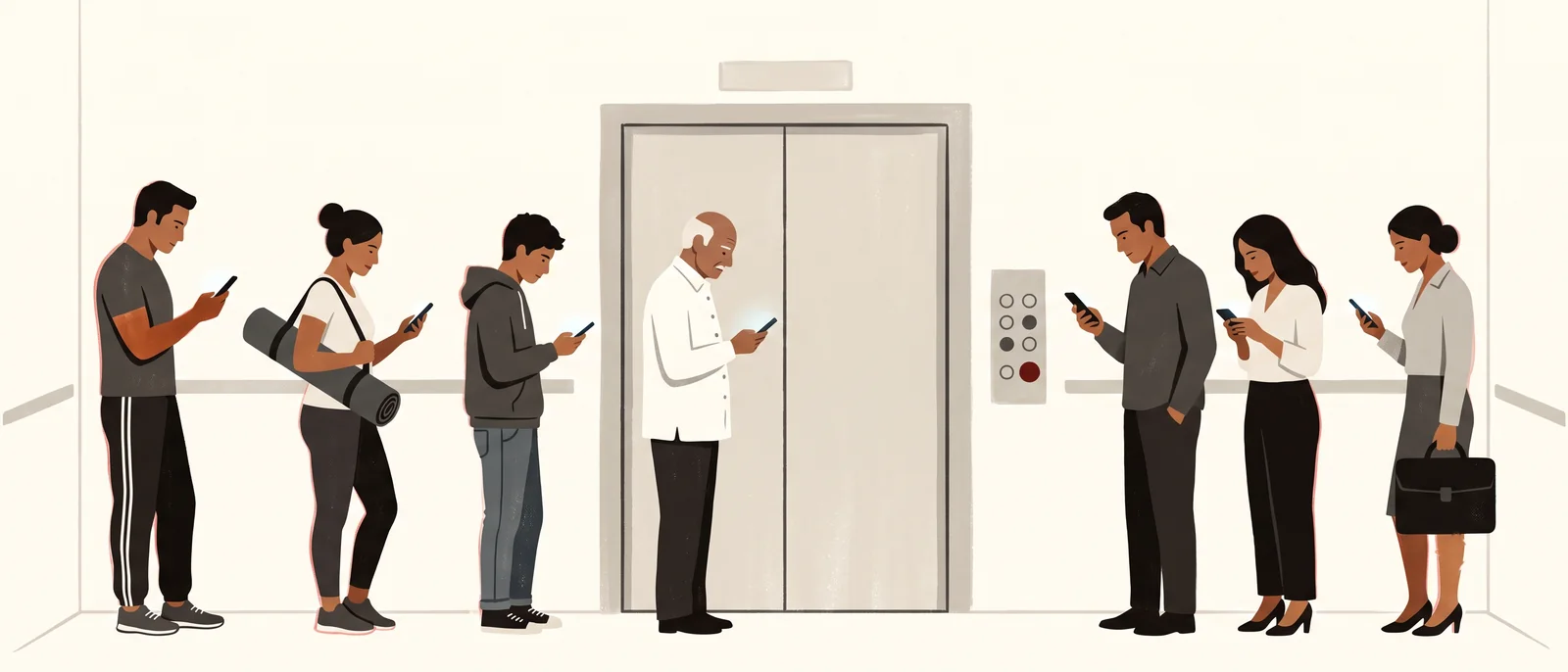
Every one of these is an improvement. Nobody wants the fish man back in preference to eleven-minute delivery. But each one took away a small, compulsory collision with another person, and nothing was put in its place, because collisions with other people had never been thought of as something a neighbourhood was for. They were a side effect. It turns out the side effect was the point.
Each convenience took away a small, compulsory collision with another person. Collisions had never been thought of as what a neighbourhood was for. It turns out the side effect was the point.
The sociologist Ray Oldenburg called the missing thing the third place: not home, not work, but the tea shop, the barber’s, the temple steps, the bench outside the ration shop, where one turns up without an appointment and is known. The development has a clubhouse, which looks like a third place and is not one. It must be booked. One goes to it to do something, with people one has brought. Nobody has ever wandered into a gated community’s banquet hall to see who was about.
The performance
There is a residents’ WhatsApp group for Tower C, with four hundred and twelve members. It is very active, and it is where the building goes to perform being a community.
Eighty per cent of it is complaint: parking, a dog, water pressure, the noise from 1406, somebody’s cook using the wrong lift. The rest is festival. At Diwali there is a rangoli competition and at Onam a sadya in the banquet hall, two hundred people at long tables, and photographs afterwards in the group, a wall of silk and smiles, captioned Our C Tower family!! Shreya went to the sadya last year. She sat between a couple who talked to each other and a man who talked to his phone. She ate well, said “Happy Onam” eleven times, was in three photographs, and went back upstairs having had no conversation. In the pictures she looks like a woman with a great many friends.
This is loneliness of the particular modern kind, which is not visible from outside and is mildly shameful from inside. She cannot easily say it to anyone. To be lonely at thirty-four, solvent, in a flat with a pool, sounds like a failure of personality. It is what people mean when they ask, with a bright concern, whether she has “tried joining something”. So she performs being fine, along with, she has begun to suspect, a fair number of the other four hundred and eleven.
What it does to a mind
Cacioppo’s most useful finding was about what loneliness does if the signal is not answered, and it is not what one would hope.
Hunger makes food more attractive. Loneliness, left to run, makes people less so. The lonely brain shifts, measurably, into a state of mild threat alert: quicker to see rejection in a neutral face, slower to trust, more likely to remember the awkward moment in a conversation than the warm one. It is an old defence, since an animal outside the group has to watch its own back. But the effect is that the lonelier a person becomes, the more guarded, prickly and self-conscious she is in exactly the encounters that might help, and the more she expects them to go badly, and the more she stays in. Loneliness makes a person worse at curing it.
This is why “just get out more” is poor advice, and why it lands as an insult. After two years the lift has stopped being a missed opportunity and become an ordeal. The thought of knocking on a door produces real dread. She is not shy. She runs workshops for sixty people. She has simply been alone for long enough that her own mind has started working against her.
The small, unfashionable remedy
What helps is, fittingly, not grand.
It is not mainly close friends, welcome as those would be. Some of the most encouraging research of the past decade is about the opposite: the people one barely knows. A psychologist called Gillian Sandstrom had people count their interactions across a day and found that those who had more passing exchanges with what sociologists call weak ties, the security guard, the woman at the pharmacy, the man walking the same dog at the same hour, were reliably happier and felt more that they belonged, on the days they had them. In another set of experiments, in Chicago, commuters were instructed to talk to the stranger next to them on the train. Beforehand they predicted it would be unpleasant and that the stranger would mind. They were wrong on both counts, almost without exception. They enjoyed the commute more than those told to sit in silence. People consistently underestimate how much a stranger would like to be spoken to, and everyone in the lift is making the same miscalculation about everyone else.
So the remedy is the thing that the development engineered away: small, repeated, low-stakes contact with the same faces. It means learning the guard’s name and using it. It means taking the stairs down at the hour the old couple on nine take their walk. It means collecting one’s own parcels. It means being in the same place at the same time each week until one becomes, without effort, a person who is nodded to. None of it is friendship. It is the soil friendship grows in, and it is also, by itself, a good deal of what the nervous system was asking for: evidence, daily, of being known to be alive.
It is a matter for builders and residents’ associations too, not only for the lonely. A bench in the right place does more than an amphitheatre. So does a tea stall allowed inside the gate, or a lobby where it is possible to sit, or one evening a week when the lifts are crowded on purpose.
The parcel the boy had left was not hers. It was for 1104, the flat directly opposite, whose door she had looked at for two years and four months. It had a brass nameplate: Col. R. Mathew (Retd.). She stood holding the box for some time. The easy thing was to leave it on his mat.
She rang the bell.
He was about eighty, in a white shirt buttoned to the neck, with a hearing aid, and he looked at her as people look at someone they are trying to place. She explained about the parcel. He said it was his tablets, thanked her, and then said, as though it followed, “You will have tea,” and went in without waiting for an answer, leaving the door open.
She stayed forty minutes. His wife had died in 2022. His son was in Perth. He had been in this flat six years and told her, without self-pity, as a point of information, that she was the first person from the building to sit in that chair. He asked her name. Ten minutes later, apologising, he asked it again.
As she was leaving he took an electricity bill from under a magnet on the fridge, turned it over, and wrote on the back, in capitals, with a ballpoint that needed shaking: SHREYA. 1103. He read it back to her to check the spelling. Then he put it under the magnet again, face out, where he would see it.

Sources
- World Health Organization Commission on Social Connection, From Loneliness to Social Connection: Charting a Path to Healthier Societies (30 June 2025). https://www.who.int/groups/commission-on-social-connection
- Cacioppo, J. T. and Patrick, W., Loneliness: Human Nature and the Need for Social Connection (Norton, 2008); and Cacioppo, J. T. and Hawkley, L. C. (2009). “Perceived social isolation and cognition.” Trends in Cognitive Sciences, 13(10), 447 to 454.
- Sandstrom, G. M. and Dunn, E. W. (2014). “Social interactions and well-being: the surprising power of weak ties.” Personality and Social Psychology Bulletin, 40(7), 910 to 922.
- Epley, N. and Schroeder, J. (2014). “Mistakenly seeking solitude.” Journal of Experimental Psychology: General, 143(5), 1980 to 1999.
- Oldenburg, R., The Great Good Place (Paragon House, 1989).
- Klinenberg, E., Palaces for the People: How Social Infrastructure Can Help Fight Inequality, Polarization, and the Decline of Civic Life (Crown, 2018).
The letter
One letter with each new piece. Nothing else, and your address goes nowhere.
We send one confirmation email. You are not on the list until you click it.
Replies
Nothing here yet.
Replies are for subscribers, signed in.
Sign inNot a subscriber yet?