The Casino in the Pocket
India banned online money games a year ago. The urge they fed did not read the notification.
Recovery · · 10 min read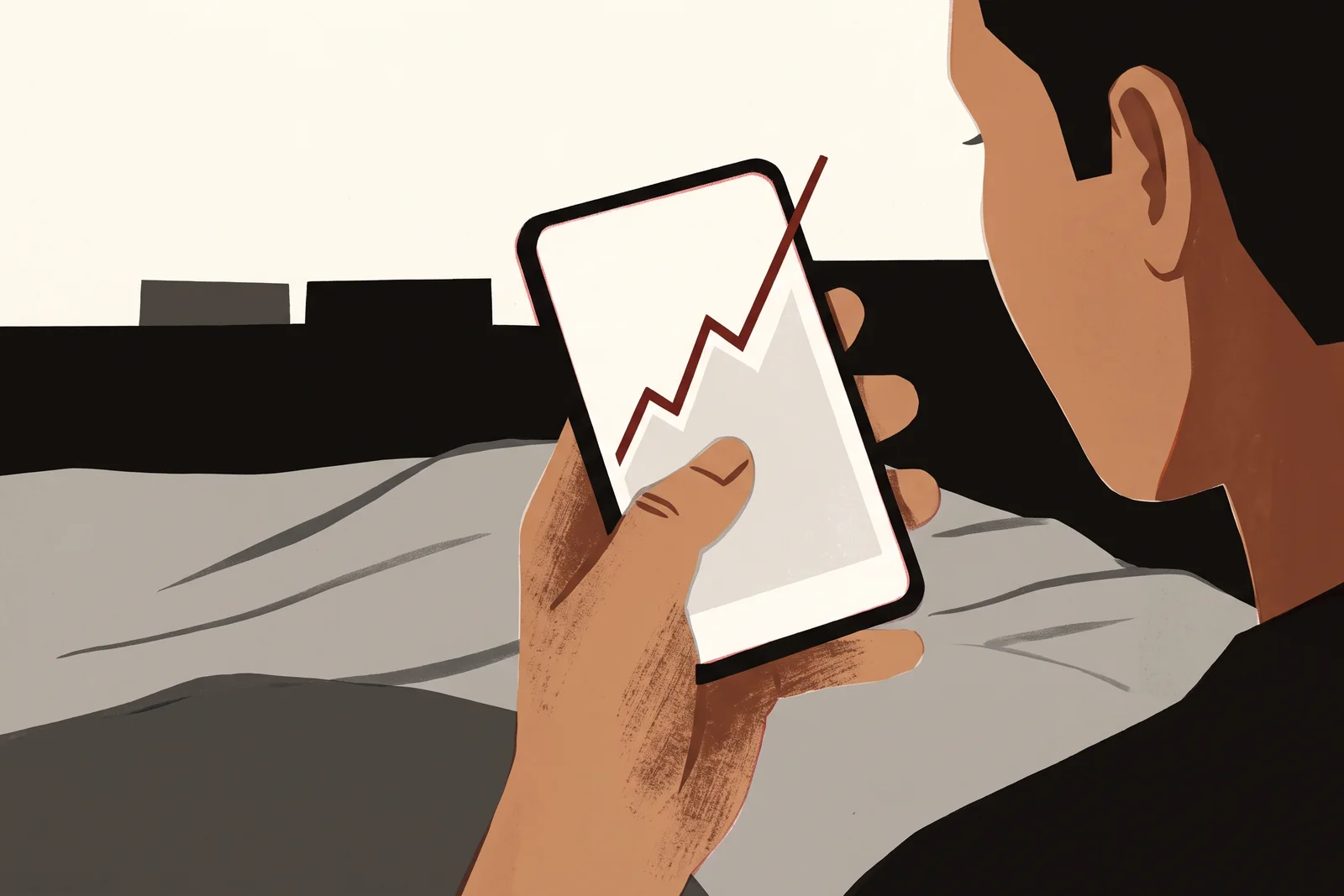
The room is asleep. The table is open.
At twenty to three in the morning, in a paying-guest room in Marathahalli with three beds and one window, Kiran is under a bedsheet with his phone at its lowest brightness. His two roommates are asleep. One has an alarm set for six. On the screen a small cartoon aeroplane climbs a graph, and beside it a number climbs too: 1.2x, 1.5x, 1.8x. The game is to cash out before the plane flies off. He has decided to cash out at two. At 1.97 the plane leaves.
He is twenty-seven and works support for a software firm. His salary, fifty-two thousand rupees, arrived on the thirtieth. Today is the second. Since midnight he is down thirty-eight thousand. The site he is playing on did not exist last week; last week’s site stopped loading on Friday, and on Saturday a Telegram channel with forty thousand members posted the new link, along with a bonus code and a row of fire emojis.
He taps to go again. It takes less time than this sentence.
Composite. Kiran is a composite, assembled from several accounts with the details changed. The apps, the hours and the amounts are typical. This piece mentions suicide. If you are in India and need to talk to someone now, Tele-MANAS is free and answers at all hours on 14416. Elsewhere, use your local emergency number.
The notification
He started, as most of his generation did, with cricket. In the summer of 2021 a fantasy app sponsored by half the national team let him pick eleven players for forty-nine rupees. It felt like a quiz about something he knew. From there he moved to rummy at lunch, then to a colour-prediction game a colleague showed him, which was not legal, and by 2024 he was a regular customer of four platforms that were, all advertised during the evening news by men he had grown up admiring.
In August 2025 Parliament banned the lot. The Promotion and Regulation of Online Gaming Act prohibited every online game played for money, skill or chance, and the rules enforcing it came fully into effect on the first of May this year. Kiran’s apps sent courteous emails about withdrawing his balance and turned themselves into free-to-play versions overnight. For about nine days he felt what a drinker feels when someone finally takes the bottles out of the house. Relief, and under it a small panic.
Then a friend forwarded the Telegram link.
The law did what a law can do. It took the betting companies off the cricket jerseys and out of the ad breaks, and it removed the look of legitimacy that had made a wager feel like a hobby. For the casual player, the one who put in two hundred rupees during a big match, that was probably enough. What it could not do was reach the people for whom it was no longer casual. One industry report this year estimated that roughly a third of former real-money players had simply moved to offshore sites, which answer to no Indian regulator and offer no way of getting money back. The advertising watchdog found that offshore betting ads rose after the ban and now make up the largest share of all the violations it tracks. More than eight thousand sites have been blocked. They come back under new names by the weekend.
An appetite does not read a government notification.
No substance, same illness
In the American manual of psychiatric diagnosis, gambling disorder sits in the same chapter as alcohol and heroin. It is the only behaviour there. The placement surprised people when it was made, and it should not have. Under a scanner, the brain of a person in the grip of betting and the brain of a person in the grip of cocaine are doing recognisably similar things.
The odd part, to anyone who has not been there, is that winning is not what hooks. If the plane reached 2x every time, Kiran would have been bored by April. What hooks is not knowing. A reward that arrives unpredictably is pursued far harder than one that arrives on schedule; this was first shown with pigeons pecking at a disc many decades ago, and every slot machine and betting app since has been an engineering footnote to that finding.
Then there is the near miss. The plane that leaves at 1.97 when he wanted 2 is a loss; the money is as gone as if it had left at 1.01. But it does not register as a loss. It registers as almost, and almost is processed by the brain as encouragement. He was close. His read was right. Go again. The games are tuned to deliver almost at a frequency no honest dice would.
Speed does the rest. A lottery ticket makes its buyer wait a week; a horse race, a few minutes. The aeroplane game resolves in about eight seconds and offers the next round before the feeling from the last one has settled. There is no walk to a counter, no cash leaving a hand, no closing time, nobody across the table to raise an eyebrow. Money moves by UPI as quickly as paying for tea, and appears on screen as coins or points, which are easier to lose than rupees. Every small friction that once slowed a gambler down has been found and engineered out.
Chasing
Betting more in order to win back what has just been lost. It is the single most reliable sign that gambling has stopped being entertainment. At a certain point the person is no longer playing to get rich. He is playing to get back to zero, and zero has become the jackpot.
The respectable table
Two rows away from Kiran at work sits a man who would never go near a betting site and says so. He considers it a vice of the uneducated. He has a demat account, three screens’ worth of charts on one laptop, and a habit of trading weekly index options during the morning stand-up with his camera off.
Everything about this is lawful. It is regulated, taxed, and taught on YouTube by men with whiteboards. It is also, on the regulator’s own figures, a pastime at which more than nine in ten individuals lose money, year after year. The markets regulator has now published the finding several times over. In the most recent count, individual traders in equity derivatives lost over a lakh crore rupees in a single year. In the regulator’s count the year before, more than four in ten of them were under thirty. And, in the detail that matters most here, the great majority of those who lost kept on trading.
None of which makes a market a casino. There are people who trade for a living with rules about size and exits that they follow on bad days as well as good ones, and for them it is closer to dull, careful work than to a thrill. The instrument is not the point. A deck of cards is not the point either. What matters is what the activity is doing for the person at twenty to three in the morning, and whether he is still the one deciding.
What you say
I have a system. It is analysis, not luck. I am up overall. I only use money I can afford to lose. I can stop whenever I like.
What you do
Double the size after a loss. Keep the app in a folder called Utilities. Know this week’s losses to the rupee and this year’s not at all. Take a loan from an app at three in the morning. Feel calm only while a position is open.

Money-shaped shame
A family can smell alcohol. They can see pupils, count strips of tablets, notice the slur on the phone. Gambling leaves nothing on the breath. A person can lose a year’s salary sitting beside his mother on the sofa during a serial, and she will think he is on WhatsApp.
So it is found late, and it is nearly always found the same way. The salary runs out on the fourth of the month. A credit card fills. Then come the loan apps, the ones that approve twenty thousand rupees in six minutes at interest nobody reads, and that ask, during installation, for access to the phone’s contacts. He borrows from a cousin with a story about a medical bill. He now has seven lenders and a spreadsheet, and the gambling has acquired a new and perfectly logical purpose: it is the only thing he does that could conceivably produce enough money to pay for the gambling.
The family finds out when a recovery agent rings the father.
Their first instinct, reliably, is to pay. They break a fixed deposit, clear the seven lenders, extract a promise, and consider the matter closed. It is an act of love, and it frequently makes things worse. It removes the consequence and leaves the illness where it was. And to the part of his mind that runs the betting, a cleared debt is fresh credit.
He is no longer playing to get rich. He is playing to get back to zero, and zero has become the jackpot.
What they meet, when they confront him, is a shame of an unusual shape. The drinker’s shame is about what he did. The gambler’s is about arithmetic: a number, precise to the rupee, that represents his stupidity and grows daily. It is the reason clinicians worry about suicide sooner with gambling than with almost any other addiction. Debt can come to feel like a room with one exit. It has others, and the first of them is usually that somebody else finds out the number.
Treatment, when it happens, looks like treatment for any addiction, with one cruel difference. A man who cannot drink safely can arrange never to touch alcohol again. A man who cannot gamble safely must go on handling money, which is his drug, every time he pays for tea. So the early months are practical and slightly humiliating. Someone else holds the banking passwords and receives the one-time codes. The salary goes to an account he cannot reach. The loan apps are deleted with a witness present. There are rooms for this, as there are for drink, full of people who look like accountants and schoolteachers because they are, and who can tell him to the week how long it takes before a cricket score is only a cricket score again.
Most people do not get that far. Far fewer seek help for gambling than for alcohol or drugs; the usual estimate is about one in ten. The rest manage it the way Kiran is managing it.
By ten past four he has clawed back to minus six thousand. It is the best he has felt all night. He is thirty-two thousand rupees better off than he was ninety minutes ago, and by the only accounting his mind will currently perform, that is a win. He turns the phone face down on the mattress and lies looking at the ceiling fan. In an hour and fifty minutes someone else’s alarm will go off.
The rent is due on the fifth. One of the loan apps has his father’s number.
The phone lights the sheet from underneath, once, and then again.
Sources
- The Promotion and Regulation of Online Gaming Act, 2025 (Act No. 32 of 2025), Gazette of India, 22 August 2025; rules in force from 1 May 2026.
- Lumikai, State of India Interactive Media Report 2025, as reported in Business Today, 23 March 2026: roughly one in three real-money gaming users shifted to offshore platforms after the ban.
- Advertising Standards Council of India, annual complaints report for 2025 to 2026: offshore betting advertisements as the largest category of violations.
- Securities and Exchange Board of India, studies of individual traders in equity derivatives, September 2024 and July 2025: 93 per cent of individual traders lost money across FY22 to FY24; 91 per cent in FY25, with net losses of about Rs 1.05 lakh crore.
- American Psychiatric Association, Diagnostic and Statistical Manual of Mental Disorders, fifth edition: gambling disorder, classed with substance-related and addictive disorders.
The letter
One letter with each new piece. Nothing else, and your address goes nowhere.
We send one confirmation email. You are not on the list until you click it.


Replies
Nothing here yet.
Replies are for subscribers, signed in.
Sign inNot a subscriber yet?