Next of Kin
The family as addiction's second patient, in seven scenes and the evidence beneath them
The Written Life · · 27 min readA note on method. The Hagen family does not exist. Carol, Wayne, Dana and the others are a composite, assembled from five decades of epidemiology, clinical description and the documented history of how the field has treated the families of people with addiction. Every detail of their lives is drawn from evidenced patterns, not from any individual case. They are here because the research has a structural problem: the harm to a family accrues across generations, and no citation can hold a generation. A household can.
Everything outside the italicised sections is real, sourced, and referenced at the end.
I. The Prescription
Anoka, Minnesota. 1978. Carol is twenty-nine.
The paper on the examination table crackles every time she shifts, so she stops shifting. Dr. Hoffman has known her since her wedding. He looks at her over the folder: headaches, four months. Sleep broken most nights. Weight down six pounds she could not spare.
“Anything at home?” he asks, but he is writing while he asks it, and the question has the weather of a formality.
She has rehearsed a sentence in the car. The sentence is about Wayne, and the cases of Hamm’s in the garage, and the sound the truck makes coming up the drive after eleven, and how she can tell from the way the door closes which night it is going to be. It is a good sentence. She has been building it for two years.
“Just busy,” she says. “The kids.”
“Nerves,” he says, kindly, and the word settles over everything like a sheet over furniture. He tears the prescription off the pad. Diazepam. Half the women on her street carry the same amber bottle; her neighbour Sharon calls them her little erasers.
At the pharmacy the man counts the tablets without looking up. No one in the building has asked her a question she could not answer with fine.
She sits in the Fairmont in the parking lot with the white bag on the passenger seat and does not open it. Dana is four. Michael is one. Wayne is at work, where he is well liked, where his hands are steady until four o’clock, where his foreman says he is the best electrician on the crew. Nothing she could report has happened. Everything is fine, and she is being treated for it.
The label says: as needed.
Lately, everything is needed.
The first fact about the family of a person with addiction is that no system is looking for them.
Jim Orford and colleagues, surveying the global evidence in 2013, estimated that addiction in the family affects around 100 million adults worldwide, and called it a major but neglected contributor to the global burden of ill-health.[1] The figure has no diagnostic code attached to it. There is no clinic for it, no registry, no budget line in any national health plan. You cannot join a waiting list for a condition nobody offers to treat.
When a country finally counted, the scale held. A German national survey of 24,824 adults found 9.5% currently living with the addiction of a family member, and a further 4.5% in the past, with significantly raised odds of poor health and depression among the affected.[2] Roughly one person in seven, in a wealthy nation with a functioning health system, carrying a burden the system had never thought to ask about. The survey’s own commentators noted it might still be an undercount, since admitting a relative’s addiction to a stranger with a questionnaire is its own stigma test. The measurement problem and the silence problem are the same problem.
And the harm is not a metaphor. Health-record studies found that family members of people with alcohol or drug dependence carry more diagnoses and higher medical costs than the family members of people with diabetes or asthma.[3] Their conditions are treated one at a time, each symptom its own file, while the common cause sits at home in somebody else’s chart.
The first fact about the family of a person with addiction is that no system is looking for them.
Carol’s diazepam belongs to a documented era. Benzodiazepines were among the most prescribed drugs in the Western world through the 1970s, dispensed disproportionately to women, for presentations exactly like hers. The system had no question for what was happening in her house. It had a tablet for how she felt about it.
Orford’s own framework, built over four decades, rejected the older clinical instinct to locate pathology in her. His stress-strain-coping-support model describes affected family members as ordinary people under extraordinary, chronic stress, whose health erodes in proportion to the strain and the absence of support.[4] It reads as obvious. Against what came before it, and what came after, it was nearly radical.
II. The Front Office
Anoka. 1983. Dana is nine and a half. The half matters to her.
Saturday begins with an assessment. She lies in bed and reads the house: the pitch of the television downstairs, whether there are two voices or one, whether the smell of coffee has made it up the stairwell. Coffee is good. Coffee means her father is vertical and remorseful and will fix the storm door today, or say he will.
No coffee this morning. Television on. One voice, which is no voice, which is the couch.
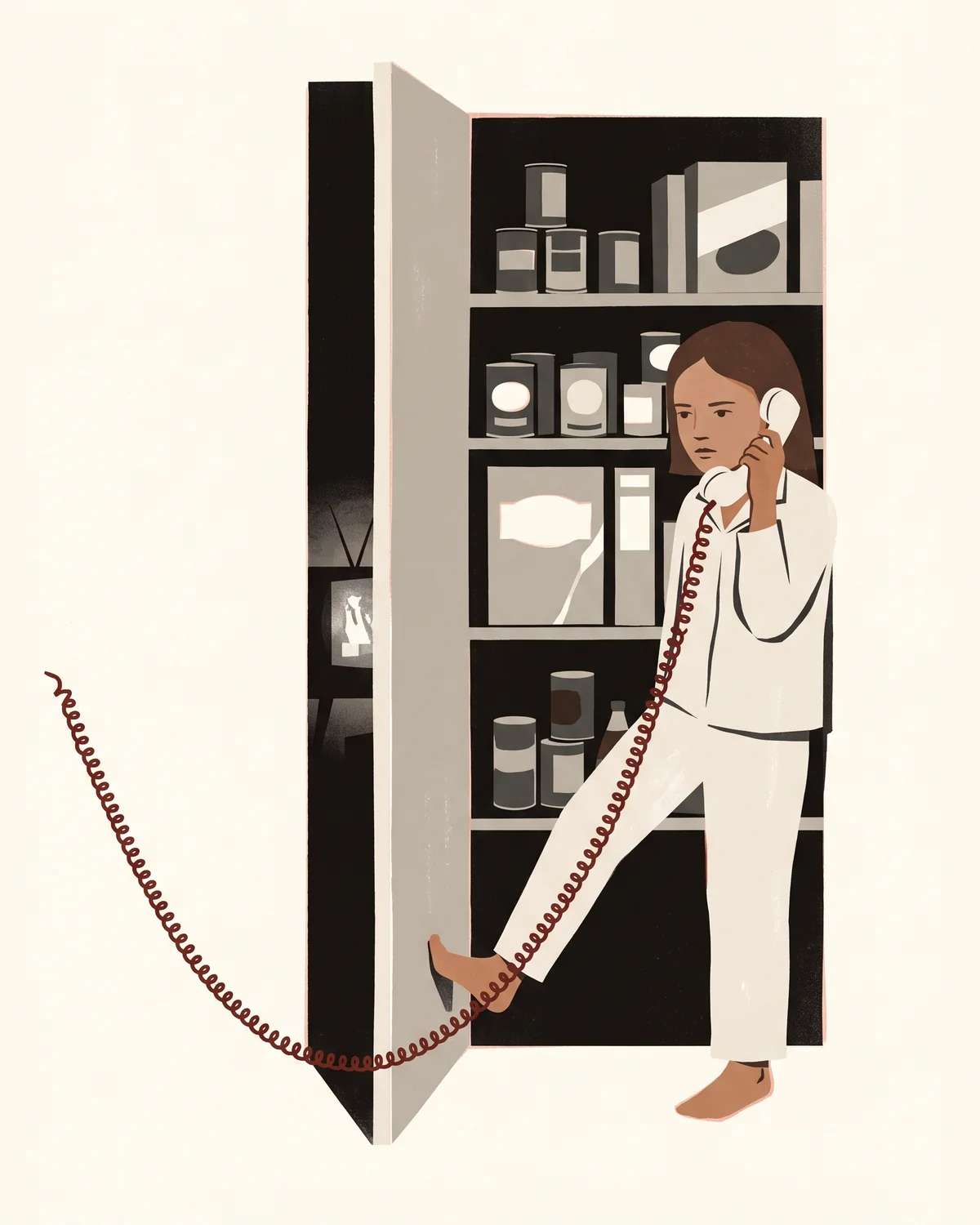
She gets Michael his cereal first because a fed six-year-old is a quiet six-year-old, and quiet is the project. Then the phone, the cord stretched to its full length into the pantry, the door held shut with her foot. She dials the number written inside the cupboard door in her mother’s hand.
“Hi, Mr. Kowalski. It’s Dana Hagen. My dad’s got that flu that’s going around.” A pause on the line. “Yeah. Yeah, he’ll be in Monday for sure.”
Mr. Kowalski says something kind and tired and hangs up. She is aware, in a way she has no words for, that the kindness and the tiredness are both about her.
Her mother is at the school office by seven on Saturdays in October, inventory season. So it is Dana who finds the permission slip for the science museum crumpled in her own bag, due Monday, and signs it at the kitchen table, practising the capital C twice on a napkin first. Carol Hagen. The pen her mother keeps by the phone.
At ten, her uncle Pete knocks. She opens the door the eight inches the chain allows.
“Dad’s sleeping. He’s got the flu.”
Pete looks at her for a moment longer than adults usually look at children. “Tell him I came by,” he says, and she watches him walk to his truck, and she closes the door, and checks the stove, and turns the television down two notches, and goes to see if Michael needs anything.
She will be thirty-eight, in a therapist’s office, before anyone suggests to her that this was work.
The field has had a name for Dana since 1973. What it has never had, anywhere, is a way of finding her while she is doing the job.
Böszörményi-Nagy and Spark called it parentification: the functional reversal in which a child becomes a parent’s parent.[5] Minuchin had described the “parental child” six years earlier.[6] The literature that followed splits the role in two. Instrumental parentification is the visible half: the cooking, the sibling care, the phone calls, the logistics. Emotional parentification is the heavier half: the child who becomes a parent’s confidant, mood-manager and early-warning system. The second is harder to see from outside, because from outside it photographs as closeness.
She will be thirty-eight, in a therapist’s office, before anyone suggests to her that this was work.
The honest part, and the part the doom narrative omits, is that the labour itself is not what injures. Jurkovic’s distinction remains the field’s most useful: caregiving harms when it is excessive, developmentally inappropriate, unacknowledged and unreciprocated.[7] Acknowledged and fairly shared, responsibility can build competence; children in many cultures carry real household roles without damage. The injury is doing it invisibly, for years, with nobody keeping score of the cost.
When it does go unacknowledged, the adult outcomes are documented: elevated depression and anxiety, and a signature the clinic knows well. The compulsive caregiver. The adult fluent in everyone’s needs except her own, who selects partners that require managing, because managed love is the dialect she learned first.
Underneath the role, two channels of transmission run in parallel. Children of alcohol-dependent parents carry roughly four times the population risk of developing the disorder themselves, with about half the general liability heritable.[8] The learned channel is quieter. A childhood spent regulating another person’s states is a childhood that never practises regulating its own; years later, substances offer to do the job chemically, on demand.
Hold the base rate before the fatalism arrives. Even at fourfold risk, most children of alcoholics never develop the disorder. The majority build ordinary lives. The tragedy script assigned to them is a second inheritance, handed over by people who read half the literature.
III. The Book
Anoka. 1987. Carol is thirty-eight.
It comes media mail from her sister Judy in Phoenix, wrapped in a grocery bag, with a card that says only: This helped me. The cover is pink and cream. Codependent No More.
Carol reads it in three nights, in the bathroom, with the fan on.
It is the strangest experience of her reading life. Whole paragraphs describe her mornings. Somebody has been in her kitchen, watched her check the level in the bottle above the fridge, watched her call Kowalski, watched her intercept the mail for the credit union envelopes, and has written it all down and printed eight hundred thousand copies. She had believed the things she did all day were too small and too shameful to have names. They have names. There is a whole vocabulary. There are meetings.
The church basement on Tuesday nights smells of coffee and carpet. The first month is the best month of her decade. Women say things out loud that she has never said in the bathroom with the fan on. The family gets sick too, somebody says, and Carol cries in a folding chair in front of strangers and nobody is embarrassed, least of all her.
It is later, further in, that the accounting starts to turn.
The workbook asks her to list the ways she has enabled. The counsellor at the family programme, the one weekend Wayne agrees to treatment in 1989, asks the wives to consider their part in the disease. A woman named Barb, four folding chairs down, says with the serenity of the converted that she had to learn she was just as sick as her husband.
Carol drives home on Highway 10 doing the new maths. She has kept two children fed, clothed, schooled and alive. She has held a job, a mortgage and a man. And the vocabulary that finally saw her has decided that this, too, is a disease, and that it is hers.
She keeps going to the meetings. The meetings are what there is.
To understand what was handed to Carol in that basement, go back thirty years before the book.
In the 1950s, psychiatry looked at the wife of the alcoholic and produced a theory: she had chosen him to satisfy her own neurotic needs, and her personality was maintaining his drinking. A 1953 paper sorted such wives into four types with tidy alliterative names.[9] The disturbed-wife hypothesis was the field’s opening position on the family of the alcoholic: a diagnosis for the person holding the household up.
The concept that reached Carol had gentler intentions and a familiar destination. Codependency emerged as shorthand in Minnesota treatment circles in the late 1970s, naming what living alongside alcoholism does to the people doing the living. In 1986 the psychiatrist Timmen Cermak formally proposed codependence as a personality disorder for the DSM, criteria included.[10] The manual declined. The market did not. Melody Beattie’s Codependent No More sold eight million copies from 1987; Co-Dependents Anonymous held its first meeting in October 1986; and within a few years the concept’s promoters had decided nearly everyone had it, at which point it stopped being a diagnosis in any meaningful sense.[11]
The research, when it finally arrived, found nothing coherent to validate. In empirical testing, codependency failed to separate as a distinct disorder; in one sample, two-thirds of those identified as codependent met criteria for conditions psychiatry already had, and Cermak’s criteria were found to lack specificity and internal consistency. The construct, the researchers noted, may describe a pattern of adaptive behaviour: situational response to living with an addicted person, renamed as character.[12]
The feminist critique said the quiet part with citations. Read the checklist beside the life it describes and every symptom is a survival strategy: hypervigilance in a person who lives with someone unpredictable, control in a person managing a household one crisis from collapse. Scholars pointed out the lineage: psychiatry had recently tried to codify a “self-defeating personality disorder,” been fought out of the manual by organised opposition, and watched the same idea return through the recovery movement, where no committee could refuse it, pinned largely on the same women.[13] One critic called the whole apparatus one more guilt trip for women.[14]
The honest ledger holds both entries. The concept gave millions of people, Carol among them, the first language that saw them, and rooms where the unsayable was said weekly. That was real, and it mattered. And the label billed her for the seeing. It took the response to harm and diagnosed it, while the harm itself sat at home, undiagnosed, watching television.
What nobody in any basement told her, because almost nobody knew, is that the year Judy mailed the book, a method already existed that could have trained her to do something. It had been published the year before. It would wait decades for anyone to offer it to a woman like her.
IV. The Chart
Anoka. 1994. Carol is forty-five.
In October she cuts the heel of her hand opening a jar of pickles, a clean shallow crescent, nothing. It is still taped at Thanksgiving. Her mother notices at the sink. “You always healed quick,” her mother says, holding the wrist, frowning, as if the hand has been substituted.
The flu in February stays five weeks and leaves a cough that stays until May. In June it is her blood pressure, and Dr. Hoffman’s young partner starts her on a white tablet and asks about salt. In August the shingles arrive across her left ribs like weather, and the partner says, brightly, that they are seeing this in younger and younger patients, isn’t that strange.
Nobody at the clinic connects the visits, because the visits live in different parts of the folder. Sleep in one entry. Pressure in another. The skin, the cough, the hand. Her chart has grown thick enough to need a second folder, and every page of it is true, and no page of it says Wayne.
Wayne has not seen a doctor since Ford was president. This is offered at barbecues as evidence of constitution.
In the waiting room in September, for the follow-up on the ribs, Carol fills out the intake form on the clipboard. Under REASON FOR VISIT she writes: shingles. Under STRESS she pauses, pen hovering over the three boxes. Low. Moderate. High.
She ticks Moderate, because High seems dramatic, and because the form does not say compared to what.
Her body was keeping the account the clinic declined to open, and by 1994 the laboratory evidence for exactly this was arriving.
In a study published the following year, researchers gave identical punch-biopsy wounds to women caring for relatives with dementia and to matched controls. The caregivers’ wounds took nine days longer to close, roughly a quarter slower, and their blood cells produced significantly less interleukin-1β on demand.[15] Companion work found that elderly carers given the influenza vaccine mounted a weaker antibody response than their non-caring peers.[16] Same wound, same vaccine, different life. Chronic vigilance, the research kept finding, is not a mood. It is an immune event.
The most famous number in this literature requires its correction, and the correction is instructive. Schulz and Beach reported in 1999 that strained spousal caregivers showed 63% higher four-year mortality than non-caregiving controls.[17] The figure went into every slide deck in the field. It applied only to spouses reporting strain, and at least five larger population studies since have found lower mortality among caregivers as a whole.[18] The famous statistic spent two decades being cited for a claim it never made. What survives the reappraisal is quieter and, for households like Carol’s, worse: consistently elevated depression and psychological distress across the caregiving literature,[19] the immune findings, and, for addiction families specifically, harm measured rather than projected: those health-record studies again, the diagnoses and costs exceeding the families of chronic medical disease.[3]
One further finding closes the loop, and it is the closest thing this literature has to a receipt. Researchers following the medical costs of family members after a relative entered addiction treatment found that as the patient stayed abstinent, the family’s own costs fell, their conditions declining alongside.[20] Treat one person and people who never sat in the chair get healthier. The evidence is sixteen years old. No health system on earth has reorganised around it.

V. The Living Room
St. Cloud. 2003. Carol is fifty-four. Dana is twenty-nine.
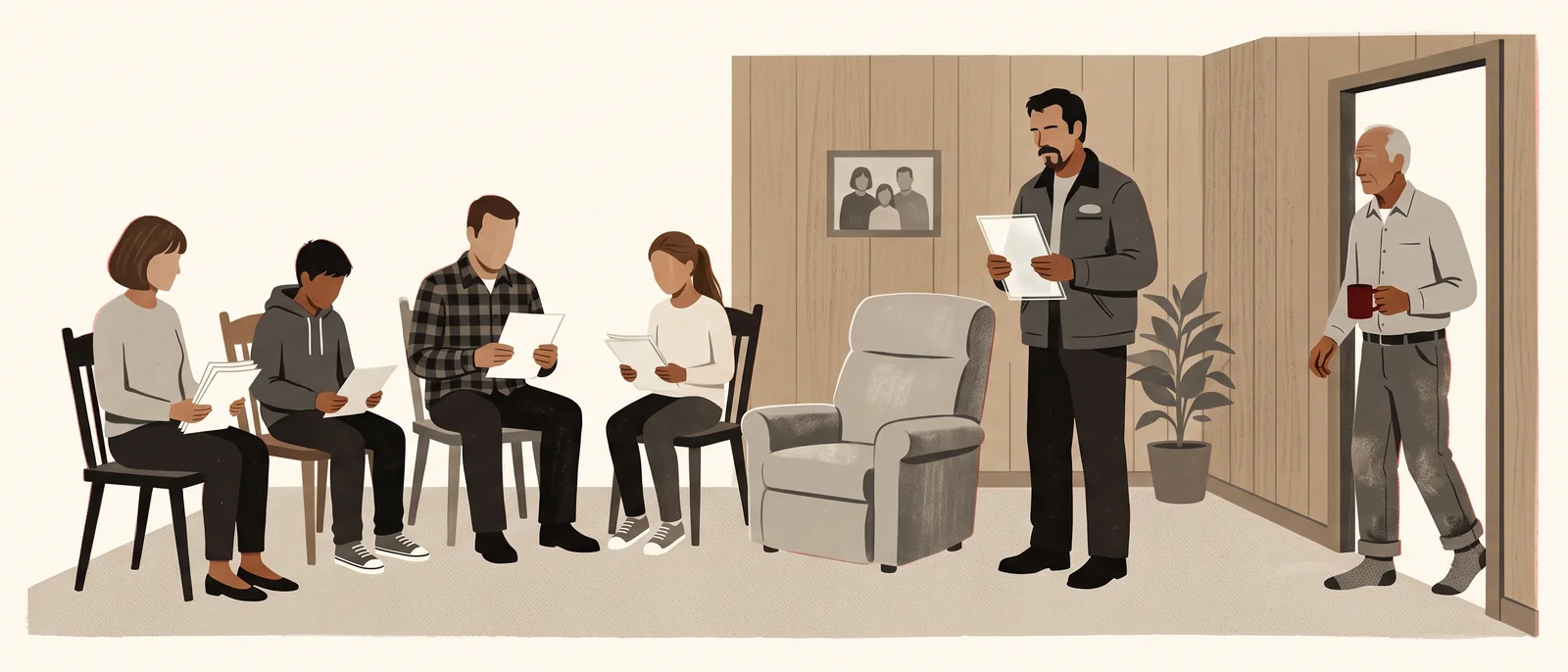
The interventionist costs eighteen hundred dollars and drives up from the Cities in a grey Taurus. His name is Gary. He has a moustache and a laminated agenda and he uses the word journey four times in the planning meeting, at which Michael is a speakerphone on the coffee table because Michael, in Denver, has said with a calm that sounded practised: I love you all. I’m not doing the ambush.
They rehearse in Dana’s apartment on the Thursday. Everyone has a letter. Gary has notes on the letters. Aunt Judy has flown in from Phoenix and keeps touching Carol’s shoulder as though checking a pot.
Saturday morning, Wayne comes in from the garage for coffee and finds his living room arranged like a parole hearing. He stands in the doorway in his socks and takes it in: the letters, the semicircle, Gary rising with his hand out.
He listens. That is the terrible part, Dana will think later. He sits in his own recliner and listens to all four letters with his hands flat on his knees, and when Judy’s voice breaks he looks at the carpet as though granting it privacy.
When it is finished he says, “Are you all done?” And then, because sixty years of Minnesota have equipped him to end any scene without raising his voice: “Well. You’ve gone to a lot of trouble.”
He agrees to the twenty-eight days. Everyone in the room understands, at some level below speech, that he is agreeing in order to make the living room stop being what it currently is.
He completes the programme. He is, the counsellors say, a pleasure to have in group. He drinks again in the ninth week, quietly, and the family’s telephone tree lights up and then goes dark, and the living room is never mentioned again by anyone, ever, which is its own kind of monument.
Driving back to St. Paul that first Saturday, Dana had grieved something she could not name. Not hope exactly. The formality of hope. They had held a ceremony, and the ceremony was the family’s entire arsenal, and everyone had dressed for it.
Here is what the field had on its shelf for the Hagens, and what it handed them instead.
The televised ambush has a name in the literature: the Johnson Institute intervention. When it was finally tested head-to-head, it engaged about 30% of treatment-refusing drinkers, and the trial recorded something the television format never shows: a large share of families assigned to the confrontation could not bring themselves to stage it at all.[21] Al-Anon facilitation, the other standard offer, engaged 13%. The honest nuance belongs on the record: across conditions, the family members’ own wellbeing improved, including when the drinker never entered treatment. The support groups do what they claim for their members. They were never designed to open the treatment door.
The third method existed the whole time. Community Reinforcement and Family Training, built by Sisson and Azrin in 1986 from the same behavioural logic as the community reinforcement work of the 1970s, trains the family member herself: no confrontation, no waiting for a bottom, a handful of structured sessions in reinforcement, communication and safety.[22] In the randomized trial, CRAFT engaged 64% of treatment-refusing drinkers, against the intervention’s 30% and Al-Anon facilitation’s 13%.[21] Extensions into drug-using populations engaged 67 to 74%.[23] A meta-analysis put CRAFT at roughly three times the engagement of the twelve-step-facilitation approaches and about twice the Johnson intervention.[24]
Read the dates against the Hagen timeline. The method was published the year before Judy mailed the book. It had trial results by 1999. The Hagens, doing everything the culture told families to do, staged their ceremony in 2003, four years after the data, seventeen years after the method, and never heard of it, because there was no clinic offering it within three hundred miles, and there is very little more of it on offer today. The best-evidenced route into treatment that exists is a trained family member, and the field left her untrained for forty years while its literature debated what to diagnose her with.
VI. The Inheritance
Maple Grove. 2016. Dana is forty-two.
The corridor outside the emergency department has a mural of loons. She has been looking at the loons for two hours. Tyler is nineteen and behind the second set of doors, and the word the paramedic used in her driveway, the word she keeps setting down and picking up again, was reversed. As in: we reversed it. As in: there was something to reverse.
Wisdom teeth, two years ago. Thirty tablets for four days of pain, because that was simply what was prescribed in 2014, to everyone, for everything. She had counted nothing. Why would she count. She has spent her whole life counting other things.
What she notices, in the weeks after, is how good she is at this. The vigilance comes back like a language from childhood, entire. She can read Tyler’s footsteps on the stairs. She can inventory a bathroom in eight seconds without appearing to look. She knows which questions close him down and asks them anyway, at the wrong times, in the doorway of his room, in the voice her mother used through a pantry door in 1983. She is thirty years past the kitchen table where she practised a capital C, and her hands still know the whole job.
At 2:17 on a Tuesday morning she is at the kitchen island with the laptop, deep in the third hour of the search that every parent conducts, past the ranch rehabs with the horses and the testimonial fonts, when she finds a university page with no photographs on it at all. An acronym. CRAFT. A claim so specific it reads almost rude among the wellness copy: in trials, roughly two-thirds of treatment-refusing loved ones entered treatment when a family member was trained in this approach.
There is a book. She orders it used, $6.40. There is a trained clinician. The nearest one is in Chicago, six hours away, and does not take insurance, because there is no code to bill this under.
The publication date on the original method is what she keeps returning to. 1986. She does the arithmetic twice. The year before her aunt mailed a pink book to a church basement, somebody had already built the thing that worked, and it had spent her entire adult life in a filing cabinet.
At the sink, at three in the morning, she practises a sentence from chapter four out loud, quietly, the way her daughter practises Spanish. It is a sentence for Thursday, for the doorway, instead of the question that closes him down.
She is the fourth person in this story to teach herself the job alone. She is the first one holding a manual.
The scale Dana joined that night has finally been counted, and the count arrived with a comic timing history will not improve on.
An analysis published in JAMA Pediatrics in 2025 put the number of American children living with a parent with a substance use disorder at 19 million, one in four, twelve million of them with a parent meeting criteria for alcohol use disorder.[25] The jump from earlier estimates was substantially the diagnostic manual catching up rather than the households multiplying. And in April of that year, the federal survey that produced the count had its entire staff handed layoff notices.[26] One in four children, counted properly at last, just in time for nobody to be left to count them again.
The children themselves reached the health-services literature only in 2014, when researchers first formally compared children in addiction-affected families against children in diabetes- and asthma-affected ones: distinct patterns of conditions, different services used, overall costs similar or somewhat higher, sitting in the same records the whole time.[27] A population the system had been billing for decades, unexamined because a diagnosis in the parent is filed as the parent’s problem.
And the transmission Dana felt in her hands has both of its channels on record: the heritable liability, and the trained vigilance: the childhood apprenticeship in reading another person’s weather that returns, decades later, fluent and unbidden, the moment it is needed again. A person’s substance use disorder affects at least two family members on average.[28] Nothing in that sentence stops at one generation.
VII. Next of Kin
Coon Rapids. 2026. Carol is seventy-seven. Dana is fifty-two.
The pre-surgical admissions desk has a clipboard and the clipboard has a form and Dana has been filling out versions of this form her whole life.
Hip replacement, elective, Thursday. Her mother sits beside her in the good coat, holding her purse on her knees with both hands, supervising. Wayne is fifteen years gone: the liver, the quiet hospice out by the fairgrounds, a nurse named Deb who called him honey and whom he permitted. At the end he held Carol’s hand and said, “You were always steady,” which was the closest he came, and which Carol has decided, after some years of consideration, to keep.
Tyler is twenty-nine. Eleven months, this time. He texted this morning: good luck grandma, tell her the hip better be titanium. Dana read it four times. She has learned not to count out loud, and not to lean her whole weight on eleven, and to answer texts within the hour because you answer while the door is open. The book with the broken spine is on her nightstand a decade later. Some sentences from chapter four she could say in her sleep. Some Thursdays they worked.
The form wants: patient name. Date of birth. Insurance. Medications, list all. Then, halfway down the second page, the box.
NEXT OF KIN. Relationship to patient.
Dana prints her own name. Under relationship she writes: daughter.
The box is one inch by three. It is, she thinks, clicking the pen, the only place in the entire apparatus of American medicine where what she has been for forty-eight years is recorded. Not the phone calls, the pantry, the intercepted envelopes, the semicircle of letters, the loons, the three a.m. Spanish at the sink. Just the box, which wants to know who to call.
She has always been who to call.
She hands back the clipboard. The receptionist smiles at the mother and the daughter, at two generations of a system’s most reliable infrastructure, and says what the system has always said to them, which is: someone will be right with you.
Coda
Trace it back from the box on the form.
A doctor with a prescription pad and no second question. A nine-year-old running a front office nobody chartered. A vocabulary that finally saw a woman and then diagnosed her for what it saw. A body keeping accounts in a folder nobody read across. A ceremony in a living room, staged four years after the data showed it was the weakest tool on the shelf. A method published in 1986 that could not be billed, and so could not be found. A count of nineteen million children, completed in the same season its counters were dismissed.
At no point in that half-century does the family fail. They call, cover, feed, drive, learn, stage, search and stay. What fails, at every point, is provision: the screening question never asked, the training never offered, the code never created, the budget line never written. A hundred million people worldwide, one in seven adults where anyone has counted, one in four American children, and the entire institutional response, across fifty years, fits in a one-by-three box that wants to know who to call.
The evidence for what would change it has been in the journals since 1986. The families have been where they have always been.
Next of kin. Untrained, unbilled, and holding.
Limitations
The Hagens are a labelled composite; no individual case is depicted, and the narrative makes no claims beyond the evidenced patterns cited. The caregiver-biology studies (wound healing, vaccine response) were conducted in dementia caregivers, not addiction-affected families; the bridge to addiction households runs through the records-based harm studies, and the text keeps the two literatures distinct. The Schulz and Beach mortality finding is presented with its subsequent reappraisal, as it must always be. The codependency section presents both the construct’s documented value to its adherents and its empirical and feminist critiques; the validation studies cited concern women, the population on whom the construct was principally tested and deployed. Engagement percentages for CRAFT, the Johnson intervention and Al-Anon facilitation derive from randomized trials with modest samples; the meta-analytic multiple is the more conservative claim.
References
- Orford, J., Velleman, R., Natera, G., Templeton, L., & Copello, A. (2013). Addiction in the family is a major but neglected contributor to the global burden of adult ill-health. Social Science & Medicine, 78, 70-77.
- Bischof, G., Bischof, A., Velleman, R., Orford, J., et al. (2022). Prevalence and self-rated health and depression of family members affected by addictive disorders: results of a nationwide cross-sectional study. Addiction, 117(12), 3140-3147. DOI 10.1111/add.15960.
- Ray, G.T., Mertens, J.R., & Weisner, C. (2007). The excess medical cost and health problems of family members of persons diagnosed with alcohol or drug problems. Medical Care, 45(2), 116-122; and Ray, G.T., Mertens, J.R., & Weisner, C. (2009). Family members of people with alcohol or drug dependence: health problems and medical cost compared to family members of people with diabetes and asthma. Addiction, 104(2), 203-214.
- Orford, J., Copello, A., Velleman, R., & Templeton, L. (2010). Family members affected by a close relative’s addiction: the stress-strain-coping-support model. Drugs: Education, Prevention and Policy, 17(sup1), 36-43.
- Böszörményi-Nagy, I., & Spark, G.M. (1973). Invisible Loyalties: Reciprocity in Intergenerational Family Therapy. Harper & Row.
- Minuchin, S., et al. (1967). Families of the Slums. Basic Books.
- Jurkovic, G.J. (1997). Lost Childhoods: The Plight of the Parentified Child. Brunner/Mazel.
- Verhulst, B., Neale, M.C., & Kendler, K.S. (2015). The heritability of alcohol use disorders: a meta-analysis of twin and adoption studies. Psychological Medicine, 45(5), 1061-1072; fourfold offspring risk per the NIAAA children-of-alcoholics literature.
- Whalen, T. (1953). Wives of alcoholics: four types observed in a family service agency. Quarterly Journal of Studies on Alcohol, 14, 632-641. See also Futterman, S. (1953). Personality trends in wives of alcoholics. Journal of Psychiatric Social Work, 23, 37-41.
- Cermak, T.L. (1986). Diagnosing and Treating Co-Dependence. Johnson Institute; and Cermak, T.L. (1986). Diagnostic criteria for codependency. Journal of Psychoactive Drugs, 18(1), 15-20.
- Beattie, M. (1987). Codependent No More. Hazelden. Eight million copies per publisher figures. Co-Dependents Anonymous first meeting, 22 October 1986.
- Martin, A.L., & Piazza, N.J. (1995). Codependency in women: personality disorder or popular descriptive term? Journal of Mental Health Counseling, 17(4), 428-440. Codependency not separable as a distinct personality disorder in women; 67% of an identified sample met criteria for one or more existing personality disorders; construct assessed as potentially describing situationally adaptive behaviour.
- Collins, B.G. (1993). Reconstruing codependency using self-in-relation theory: a feminist perspective. Social Work, 38(4), 470-476; Anderson, S.C. (1994). A critical analysis of the concept of codependency. Social Work, 39(6), 677-685. The self-defeating personality disorder history: proposed for DSM-III-R, relegated to the appendix after organised opposition, removed entirely from DSM-IV (1994).
- Tavris, C. (1990). “One more guilt trip for women.” Los Angeles Times syndicated commentary.
- Kiecolt-Glaser, J.K., Marucha, P.T., Malarkey, W.B., Mercado, A.M., & Glaser, R. (1995). Slowing of wound healing by psychological stress. The Lancet, 346(8984), 1194-1196.
- Kiecolt-Glaser, J.K., et al. (1996). Chronic stress alters the immune response to influenza virus vaccine in older adults. PNAS, 93, 3043-3047; replicated in Vedhara, K., et al. (1999). The Lancet, 353, 627-631.
- Schulz, R., & Beach, S.R. (1999). Caregiving as a risk factor for mortality: the Caregiver Health Effects Study. JAMA, 282(23), 2215-2219.
- Reappraisal literature including Brown, S.L., et al. (2009); Fredman, L., et al.; O’Reilly, D., et al.; Roth, D.L., et al. (2013-2015): population-based samples finding reduced mortality among caregivers overall.
- Pinquart, M., & Sörensen, S. (2003). Differences between caregivers and noncaregivers in psychological health and physical health: a meta-analysis. Psychology and Aging, 18(2), 250-267.
- Weisner, C., Parthasarathy, S., Moore, C., & Mertens, J.R. (2010). Individuals receiving addiction treatment: are medical costs of their family members reduced? Addiction, 105(7), 1226-1234.
- Miller, W.R., Meyers, R.J., & Tonigan, J.S. (1999). Engaging the unmotivated in treatment for alcohol problems: a comparison of three strategies for intervention through family members. Journal of Consulting and Clinical Psychology, 67(5), 688-697.
- Sisson, R.W., & Azrin, N.H. (1986). Family-member involvement to initiate and promote treatment of problem drinkers. Journal of Behavior Therapy and Experimental Psychiatry, 17(1), 15-21.
- Meyers, R.J., Miller, W.R., Smith, J.E., & Tonigan, J.S. (2002). A randomized trial of two methods for engaging treatment-refusing drug users through concerned significant others. Journal of Consulting and Clinical Psychology, 70(5), 1182-1185; and Meyers, R.J., Miller, W.R., Hill, D.E., & Tonigan, J.S. (1998). Community reinforcement and family training (CRAFT): engaging unmotivated drug users in treatment. Journal of Substance Abuse, 10(3), 291-308.
- Roozen, H.G., de Waart, R., & van der Kroft, P. (2010). Community reinforcement and family training: an effective option to engage treatment-resistant substance-abusing individuals in treatment. Addiction, 105(10), 1729-1738.
- McCabe, S.E., et al. (2025). US children living with a parent with substance use disorder. JAMA Pediatrics. DOI 10.1001/jamapediatrics.2025.0828.
- NSDUH staffing: layoff notices to the survey’s staff reported April 2025 amid SAMHSA restructuring; University of Michigan and NIH summaries.
- Ray, G.T., Mertens, J.R., & Weisner, C. (2014). Comparison of health care needs of child family members of adults with alcohol or drug dependence versus adults with asthma or diabetes. Journal of Developmental and Behavioral Pediatrics, 35(4), 282-291. PMID 24799266.
- Copello, A., Orford, J., Velleman, R., Templeton, L., & Krishnan, M. (2000). Methods for reducing alcohol and drug related family harm in non-specialist settings. Journal of Mental Health, 9(3), 329-343.
The letter
One letter with each new piece. Nothing else, and your address goes nowhere.
We send one confirmation email. You are not on the list until you click it.
Replies
Nothing here yet.
Replies are for subscribers, signed in.
Sign inNot a subscriber yet?