The Second Year
The first year of sobriety has an audience. The second has a Tuesday.
Recovery · · 9 min readThe bar at the reception has been hired for the evening, along with a bartender in a waistcoat who flips bottles for the cousins from Dubai. Arvind stands four feet from it holding a fresh lime soda, sweet and salt, in a glass that looks enough like a gin and tonic to stop people asking. He is forty-four. He has not had a drink in fourteen months. An uncle on his mother’s side, already flushed, puts a hand on his shoulder and says what uncles say, that one peg at a nephew’s wedding never killed anybody. Arvind smiles and says he is driving, which is true, and the uncle moves on to someone more fun.
Nobody at this wedding knows the number. A year ago they would have. At three months his sister sent a cake to the house. At six his wife, Sunita, cried in the car after a dinner where he had refused wine without being asked twice. At a year there was a small medallion, a room of people clapping, and his father, who does not say such things, saying it on the phone. Then the counting stopped being news. His sobriety became a fact about him, like his height.
He drives home at eleven with his family asleep in the car, and what he feels is hard to report to anyone who was hoping for gratitude. He feels flat. He has felt flat since about March.
Composite. Arvind is a composite. The details are drawn from several people and altered so that none of them can be recognised. What happens to him happens to a great many.
People who work in addiction treatment know something that seldom makes it onto a brochure. The first year of sobriety is the dramatic one, and drama, whatever else it costs, holds a person up. The second year is where a large number of people quietly get into trouble, and they get into it on days when nothing is wrong.
The year with an audience
Consider what the first year supplies. There is an enemy, and the enemy is obvious. There is a calendar: thirty days, sixty, ninety, six months, each with its small ceremony. There is a body putting itself back together at a speed you can feel, sleep that returns in the second month, a face that loses its swelling, blood reports that make a doctor raise his eyebrows in the good way. There is a family watching, frightened and hopeful, which is a quality of attention most adults have not had since they were learning to walk. Every refusal is an achievement. Every ordinary Wednesday goes up on the board as a win.
For many there is also a stretch that people in the rooms call the pink cloud.
Pink cloud
A run of weeks, early on, when a newly sober person feels unreasonably well. Energy, optimism, plans for a business. It is partly a body relieved of a poison and partly the lift of having finally done the frightening thing. It is real and it is pleasant and it ends. Nobody mentions that the ending is normal, so when it comes it feels like failure.
By month fourteen all of this has been withdrawn, and nobody withdrew it out of cruelty. It ran its course. The body finished its obvious repairs. The family, reasonably, exhaled and went back to their own lives. The milestones thin out: after the first anniversary the next one anybody marks is the second, and twelve months is a long way to walk without a signpost. Even the enemy has gone vague. Arvind does not crave whisky most days. He could not tell you what he is fighting, which makes it difficult to feel that he is winning.
What the drink was explaining
The hardest discovery of the second year is that the drinking had been doing a second job. It was the explanation.
For a decade, everything unsatisfactory in Arvind’s life had a single cause, agreed upon by everyone, including him. The stalled career was the drinking. The distance in the marriage was the drinking. The fact that his son, at fifteen, spoke to him in the tone one uses with a bank’s customer care line was the drinking. Remove the drinking, the theory went, and the rest would right itself, like a picture straightened on its nail.
He removed the drinking. The career is still stalled; it turns out he was passed over twice for reasons to do with how he handles disagreement, a habit older than the whisky. The marriage is more peaceful and no closer. His son is polite. Sobriety did what it promised and no more. It gave him back his life, and his life, on inspection, was the one he had been drinking to avoid.
He had expected a promotion. He got a transfer.
Sobriety gave him back his life, and his life, on inspection, was the one he had been drinking to avoid.
This is when the thought arrives, usually in a reasonable voice: if this is all it is, what was the point? It does not announce itself as a wish to drink. It presents as a fair question about value for money. People in their second year are rarely tempted by the old chaos. They are tempted by the idea that they could now drink like a normal person, having shown for a year and more that they can do without. The proof of control becomes the argument for surrendering it. It is an elegant trap, and the mind builds it without help.
The anger arrives late
Something else happens around now, inside the house, and it blindsides nearly everyone.
In the first year Sunita was careful. She had read, or been told, that stress could send him back, and so she managed the weather at home the way she had managed it for years, only now in the service of his recovery. She did not raise the money he had lost. She did not mention the night of her brother’s fortieth. She was kind, and watchful, and tired.
Somewhere past the first anniversary she stopped being afraid. And when the fear went, what was underneath it came up. She is angry now in a way she never allowed herself while he was drinking, when anger was dangerous, or during his first year, when it felt like sabotage. She is angry about 2019. She brings it up while they are putting away the groceries. Arvind, who believes with some justice that he has done the hardest thing of his life, hears this as the goalposts moving. He got sober and she got furious. From where he stands it looks like punishment for improving.
It is closer to a compliment, though it would be unwise to tell either of them so at the time. She is angry because for the first time in years there is someone at home solid enough to be angry at.
Families are rarely warned about this. They are told the first year is the hard one. So when the second year brings the arguments the first year postponed, both of them conclude that something has gone wrong. What has happened is that the marriage has finally begun the conversation it had been too frightened to have.
Seven to eleven
Then there is the matter of time. An addiction is, among other things, a full schedule. Drinking the way Arvind drank took planning, procurement, concealment, the drinking itself and the recovery from it, and that is before counting the hours spent thinking about all of the above. Call it four hours a day. Every evening from seven to eleven had an occupant.
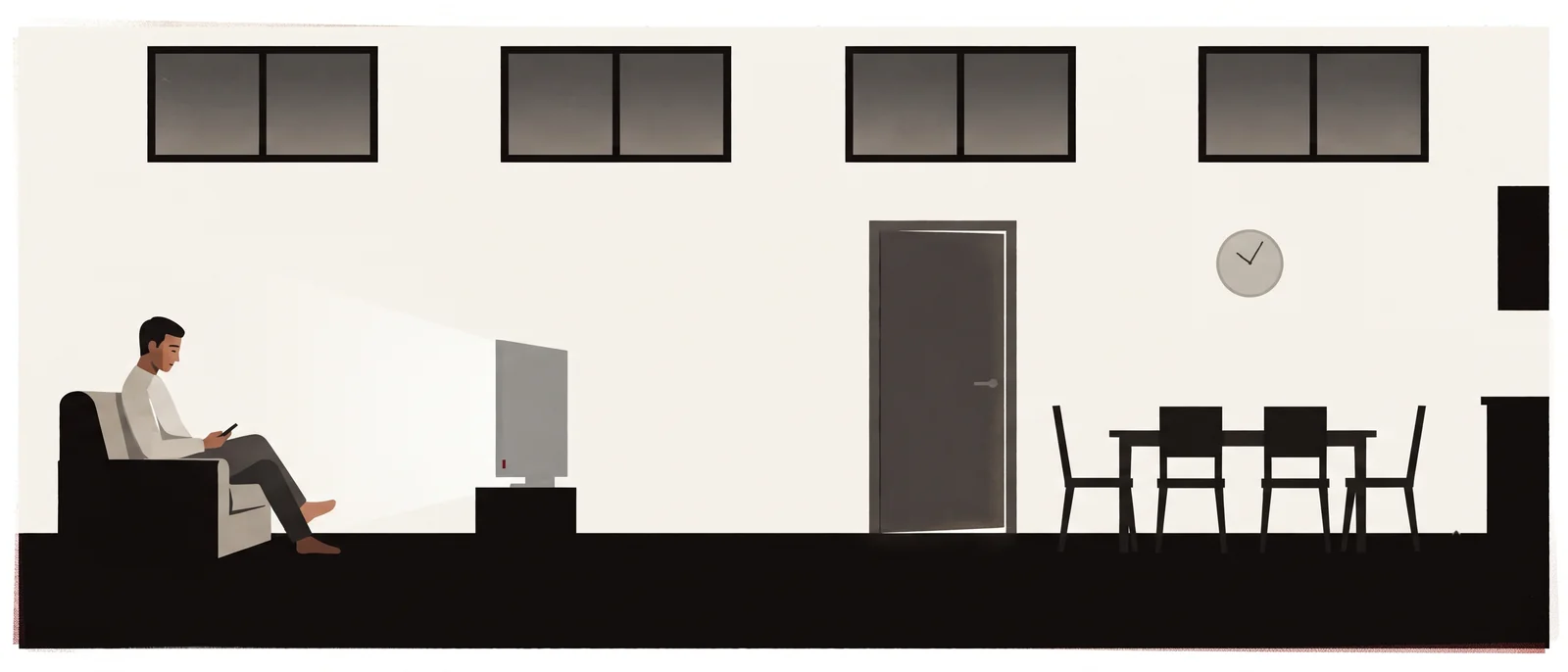
Those hours are now empty. In the first year the emptiness was disguised by novelty, by meetings, by the project of not drinking. In the second year they are only evenings. He scrolls. He watches half of things. He has detailed opinions about a web series he does not like. He is, for the first time since his twenties, bored, and he has no memory of how that is done, because for twenty years boredom had a remedy that worked in nine minutes.
Boredom sounds like a small complaint. In the second year it is the main one. Fewer people than you would think go back to drinking because of a tragedy. A great many go back because of a long run of evenings.
There is a bodily side to the flatness. A brain that has been flooded from outside for years takes its time believing the flood is over. While it adjusts, ordinary pleasures register faintly. The volume comes back up over months, unevenly, and nobody feels it rising. They notice one day that they laughed at something and meant it.
Who are you now
For fourteen months Arvind’s identity was a man getting sober. That was a job with a clear description. Before that, for much longer, he was a man who drank, which was also a job, with worse conditions. He now has to be something that is not defined by alcohol in either direction, and he is discovering that he does not know what he likes.
That is meant literally. He does not know whether he enjoys parties, because he has not attended one sober since college. He does not know whether he finds his oldest friends funny. He took up running in his fourth month with the zeal of a convert and gave it up in his tenth, and he is unsure whether he stopped because of his knee or because nobody was impressed any longer. He is forty-four and auditioning hobbies like a teenager, with a teenager’s embarrassment and none of a teenager’s time.
The people who come through the second year tend to look unremarkable while they do it. They are not the ones giving talks. What they seem to share is a willingness to let life get small before it gets good. They stop waiting for sobriety to pay out in a lump sum. They build a week: a standing thing on Tuesday, a person they ring on Thursday, a Sunday morning that belongs to somebody else. They keep going to whatever they were going to, the meeting or the counsellor or the friend who knows, well after they have stopped feeling the need, on the theory that the feeling of not needing it is poor evidence. They tell someone about the flatness instead of filing it under ingratitude. They let the wife be angry and they stay in the room.
None of it photographs well. A second year of sobriety contains almost nothing a person could post.
In September, on a Tuesday, Arvind comes home at half past seven. Sunita is on a call. His son is in his room with the door shut, which is where fifteen-year-olds are kept. There is dal on the stove. He stands in the kitchen with his laptop bag still on his shoulder and notices that he is not counting anything, not days, not the hours until bed. He is a man in a kitchen who has to decide what to do with an evening.
He puts the bag down and starts on the rice.
The letter
One letter with each new piece. Nothing else, and your address goes nowhere.
We send one confirmation email. You are not on the list until you click it.

Replies
Nothing here yet.
Replies are for subscribers, signed in.
Sign inNot a subscriber yet?