The Message at 10.40 p.m.
A bill that would let Indians ignore the office after hours has sat in Parliament since December. Even if it passed, it would not reach the real problem.
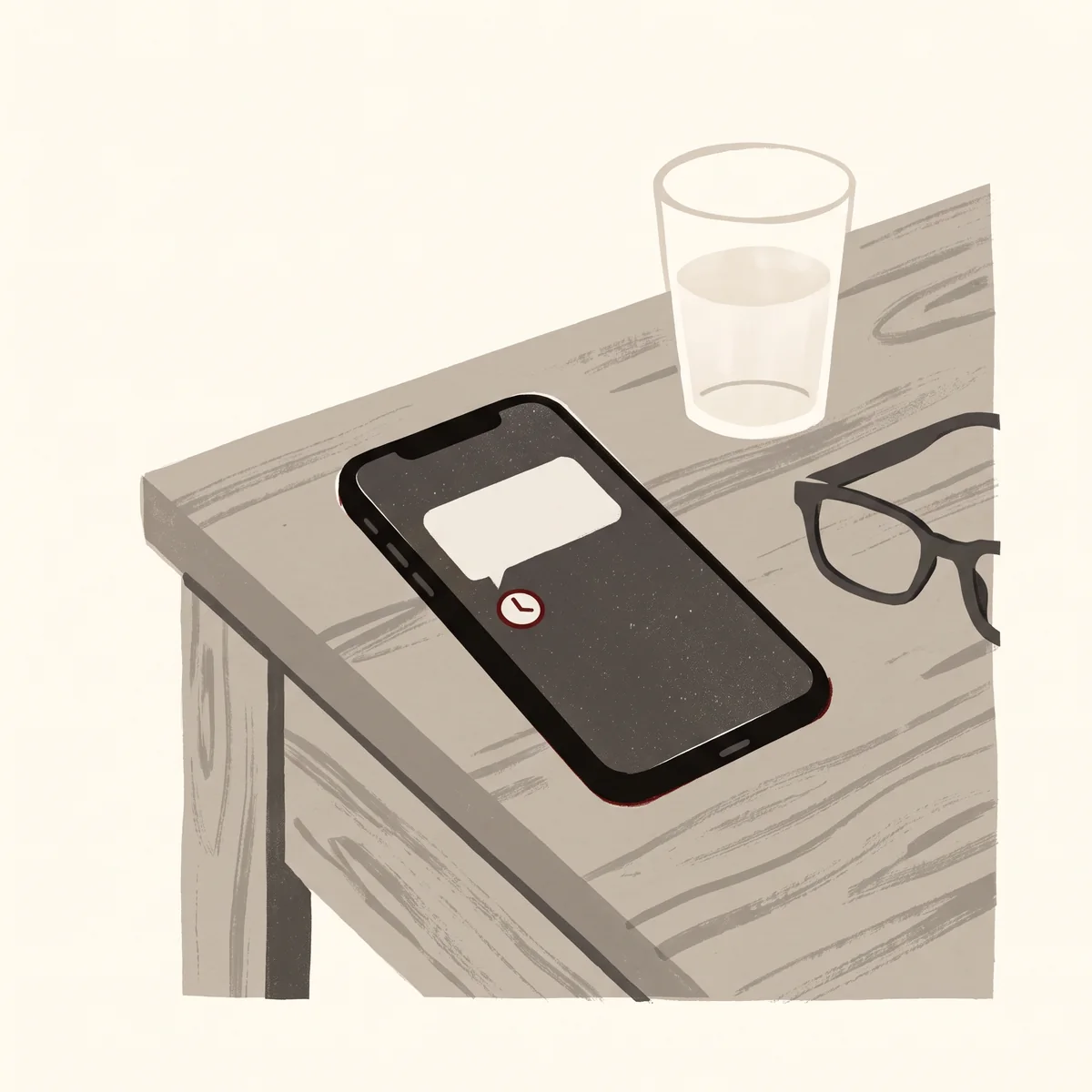
Work · · 4 min readAt twenty to eleven on a weeknight a phone lights up on a bedside table in Whitefield. It is a WhatsApp message from a manager: Can you look at slide 7 when you get a chance? No deadline is given. No reply is demanded. The phrase “when you get a chance” has been chosen with care.
The reply goes out at 10.52.
It is two years this month since a mother’s letter went round the country. Her daughter, a chartered accountant of twenty-six, had died four months into her first job at a large firm, and the letter described the hours, the late-night assignments, and a culture that treated overwork as normal. The argument it began has not stopped. In the same stretch a well-known founder has gone on recommending the seventy-hour week, an infrastructure chairman has regretted that he cannot make his staff work Sundays, and in December a member of the Lok Sabha introduced the Right to Disconnect Bill, 2025, which would give employees a legal right to ignore work calls and messages outside agreed hours without penalty. Kerala has a bill of its own. Neither has moved. Private members’ bills almost never do.
Meanwhile the figures sit where they were. The International Labour Organization puts the average Indian working week at close to forty-seven hours, among the longest anywhere, with about half of all workers past forty-nine.
Suppose the bill passed tomorrow. It would help at the edges. It would give a brave employee something to point to, and it would make the worst offenders more careful in writing. France has had such a law since 2017. The French still check their email at night.
The reason is in the message itself. Nobody ordered anyone to look at slide 7. The manager will say, truthfully, that he was only getting it off his own plate before he forgot. A law can forbid a demand. It cannot forbid an ambiguity, and the pressure lives entirely in the ambiguity. The employee lying in bed is not weighing an instruction. She is weighing what silence will be taken to mean: about her commitment, about how she compares with the colleague who will answer by eleven, about where she will stand in March.
A law can forbid a demand. It cannot forbid an ambiguity, and the pressure lives entirely in the ambiguity.
Researchers have a name for the itch, telepressure, and the finding about it that matters is this: what wears people down is less the hours actually spent on late messages than the state of being permanently on call. A mind that might be summoned at any moment never quite stands down. Recovery from work, the studies keep showing, requires psychological distance from it, and a phone that could light up is enough to prevent that, even on the nights it stays dark.
So the fix, such as it is, belongs to the person holding the other phone. It costs a manager nothing to schedule the message for nine the next morning; every email and messaging tool now has the button. It costs a little more to say to a team, in so many words, I write at odd hours and I do not expect an answer until morning, and then to prove it, by visibly not rewarding the person who replies at 10.52.
Few do, and the reason is not cruelty. Most of them once lay in the same bed, with the same phone, working out what silence would be taken to mean. They answered by eleven. It is how they became managers.
Sources
- The Right to Disconnect Bill, 2025, a private member’s bill introduced in the Lok Sabha by Supriya Sule on 5 December 2025; and the Kerala Right to Disconnect Bill, 2025. Summarised in L&E Global, “India: 2026, Looking Ahead”. https://leglobal.law/countries/india/india-2026-looking-ahead/
- International Labour Organization, working time statistics for India: average weekly hours of about 46.7, with about 51 per cent of workers exceeding 49 hours.
- Barber, L. K. and Santuzzi, A. M. (2015). “Please respond ASAP: workplace telepressure and employee recovery.” Journal of Occupational Health Psychology, 20(2), 172 to 189.
- Sonnentag, S. and Fritz, C. (2015). “Recovery from job stress: the stressor-detachment model as an integrative framework.” Journal of Organizational Behavior, 36(S1), S72 to S103.
The letter
One letter with each new piece. Nothing else, and your address goes nowhere.
We send one confirmation email. You are not on the list until you click it.
Replies
Nothing here yet.
Replies are for subscribers, signed in.
Sign inNot a subscriber yet?