Paid in Wine
The developmental architecture of alcohol dependence, in seven scenes and the evidence beneath them
The Written Life · · 27 min readA note on method. Danie Fortuin does not exist. He is a composite, assembled from the epidemiology and from three decades of clinical description, and every detail of his life is drawn from documented patterns rather than from any individual case. He is here because the science has a problem the science cannot solve: dependence takes thirty years to build, and a citation cannot show you thirty years. A man can.
Everything outside the italicised sections is real, sourced, and referenced at the end.
I. The Bell
1989. He is nine.
The bell on the Breede River farm rings five times between first light and the end of the working day, and only one of those times is for food.
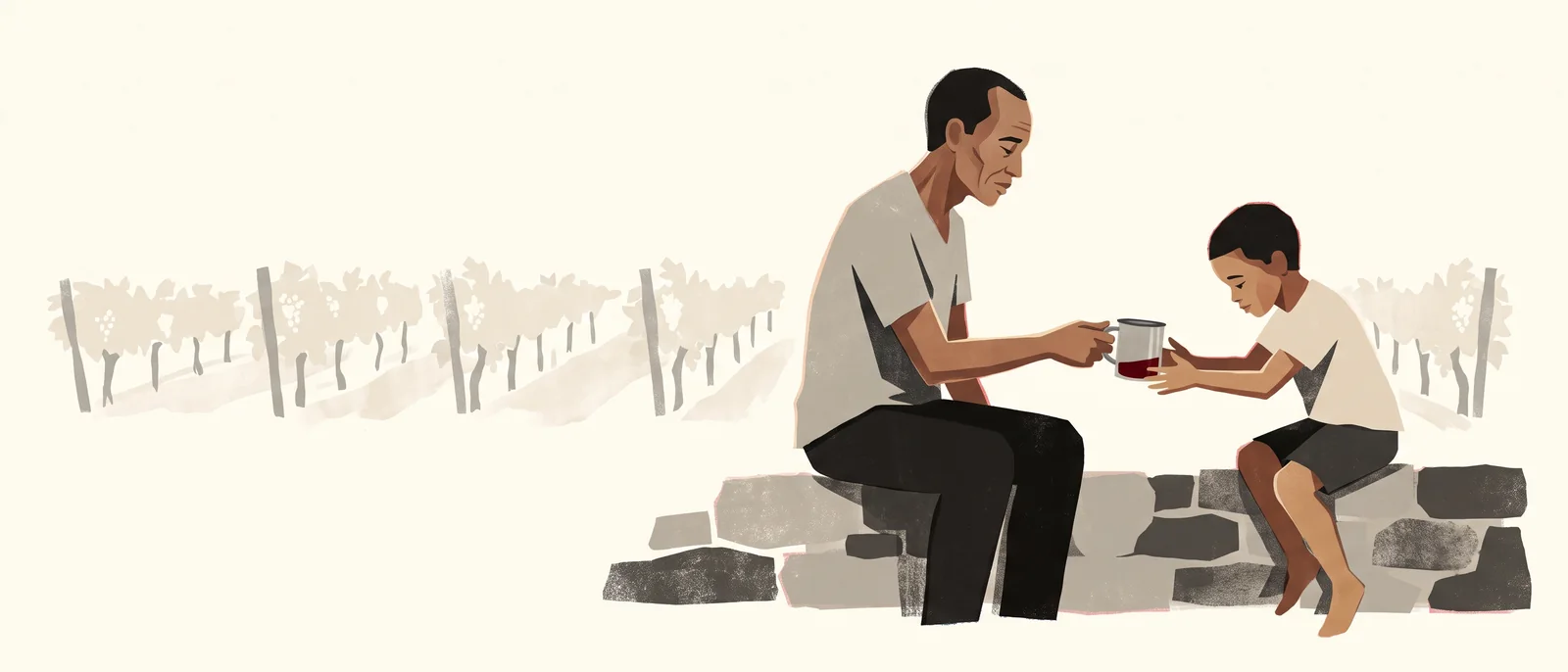
Danie sits on the low wall by the shed and watches the line form. Twenty-odd men, his father among them, each holding a tin. The foreman pours from a jerry can. The wine is sweet and cloudy and warm from standing in the sun, and it goes down in one go, and then the men go back into the vines.
His father is forty-one and looks older than the farmer, who is sixty.
When the line breaks up his father comes over and sits, and hands him the tin with a finger of wine still in the bottom. Not as a lesson. Not as a ceremony. The way you hand a child the last of your tea.
“Klein bietjie,” he says. A little bit.
It tastes like something gone off. Danie drinks it anyway, because his father is watching and there is nothing else on offer, and his father laughs at his face and takes the tin back.
His mother is inside, seven months along with the sister who will be born small and stay small, and who will still be in Grade 1 at nine years old, and whom the teachers will describe, for the rest of her schooling, as a slow child.
The dop system was not a custom. It was a wage.
The practice of issuing wine to farm workers at intervals through the working day was general across the Cape winelands by 1890, and its lineage runs directly back to the slave society established at the Cape from 1658.[1] On some farms wine was distributed five times a day.[2] A district surgeon giving evidence to the Liquor Laws Commission in 1890 described the mechanism with a clarity nobody has improved on since: the first drink taken in the very early morning on an empty stomach, which “at once starts the craving for the stimulant, which is taken in a greater or less degree throughout the day.”[1]
It was made illegal in 1961. A loophole permitting alcohol as a gratuity or reward kept it running for decades afterward.[2] The Western Cape Liquor Act now provides for fines of up to R1 million.[3] Researchers were still documenting its effects on farms in the 2010s, including workers over fifty who expected their dop and farm managers who found it difficult to wean them off it.[2]
Consider what that system actually did, in the language of behavioural science rather than of history.
It established alcohol as the medium of exchange between labour and reward. It timed exposure to the working day, producing the most reliable reinforcement schedule available. It began the exposure in childhood, informally, through fathers. And it did all of this to a population held in place by law, by poverty, and by the absence of anywhere else to go.
The result is the highest recorded prevalence of foetal alcohol spectrum disorders anywhere on earth. Among Grade 1 pupils in parts of the Western Cape, FASD has been estimated at 196 to 276 per 1,000 children, between one child in five and one in four.[4] One community sample returned a weighted estimate of 310 per 1,000.[5] The global figure is 8 per 1,000.[6]
South Africa’s national FAS prevalence has been estimated at 58.5 per 1,000, roughly five times that of Croatia, which holds second place.[7]
Danie’s sister is one of these children. So, statistically, is a quarter of her class.
Now add the inheritance. Twin and adoption studies have converged for four decades on a heritability estimate for alcohol use disorder of around 50%.[8] Children of alcohol-dependent parents carry roughly four times the population risk. The genes are half of that transmission. The other half is a house in which a child learns, before he has the language to examine it, what an adult reaches for at the end of a hard day.
Then add the adversity. Felitti and Anda’s study of Kaiser Permanente patients, 9,508 of them in its first report, found that four or more adverse childhood experiences carried a 7.4-fold increase in the odds of alcoholism against a score of zero, with a clean dose-response across the range.[9] Farm labour communities under the dop system carry those exposures in volume: household substance use, violence, economic precarity, disrupted caregiving.
By the time Danie takes that finger of wine from his father’s tin, four independent risk architectures are already in place, and he has not made a single decision.
II. The Year of the Election
1994. He is fourteen.
Everyone talks about April for months. His mother queues for four hours in the sun and comes back and does not say anything about it, and cries in the kitchen, and does not explain.
In August, behind the school, Danie and three older boys share two litres of Autumn Harvest that someone’s cousin bought at the bottle store in town.
Here is what he notices, and what he will still be able to describe thirty years later.
Wynand, who is seventeen, goes soft and slow after four cups and sits down against the wall and stops talking. Boeta goes quiet too. Danie keeps going. He is funny that night. Properly funny, the kind that makes older boys laugh at things he says. He is fourteen and he has never once in his life been that.
He drinks past the point where the other two stop, and nothing arrives to make him stop, and he walks home along the road under a sky full of stars feeling like a person who has finally been told a secret.
He remembers the walk. He does not remember the last hour behind the school at all, and it does not occur to him to find that strange.
What Danie noticed was real, and it is one of the most consequential findings in the field.
Adolescents are less sensitive than adults to the effects of alcohol that terminate a drinking session, chief among them sedation and motor impairment. They are simultaneously more sensitive to its social facilitation and rewarding effects. Linda Spear’s programme of work established this asymmetry and named its consequence precisely: adolescents are relatively insensitive to the very effects that serve as cues to moderate intake.[10]
The mechanisms are partly understood. Delayed maturation of the GABA system appears to underlie the blunted sedation. Overexpressed NMDA receptors in the adolescent hippocampus underlie the sharper memory disruption.[10] Much of the mechanistic work is rodent, with growing human corroboration, and that caveat belongs on the record.
The developmental picture around it is now standard. The reward system comes fully online at puberty. The prefrontal architecture that evaluates, delays, and refuses is still under construction into the mid-twenties. There is a window, roughly a decade wide, in which a person is maximally driven toward reward and minimally equipped to regulate it.
Alcohol arrives, in almost every culture on earth, exactly then.
Put the two facts together and the picture is worse than it first appears. The adolescent can drink further before anything stops him, and while he is doing it he is laying down less memory of having done it. The brake and the damage run on separate circuits. What we file under funny story is a neurodevelopmental finding.
Alcohol arrives, in almost every culture on earth, exactly then.
The epidemiology follows. Grant and Dawson’s analysis of the National Longitudinal Alcohol Epidemiologic Survey found that those who began drinking before age 15 were roughly four times likelier to meet criteria for dependence than those who began at 20 or later.[11]
The honest caveat is essential, and it is the one most writers omit. Maimaris and McCambridge argued in 2013 that the evidence for a causal link between early onset and later dependence is thinner than the field generally assumes, and that early drinking may function partly as a marker of pre-existing risk rather than as a cause.[12] That critique is sound. It also does not rescue anyone, because whether early exposure causes the disorder or merely marks it, the fifteen-year-old who is already carrying the risk is the one the environment reaches first.
III. Nine Outlets
1999. He is nineteen.
Delft. A room in his aunt’s house, R200 a month, and work on a building site in Bellville when there is work.
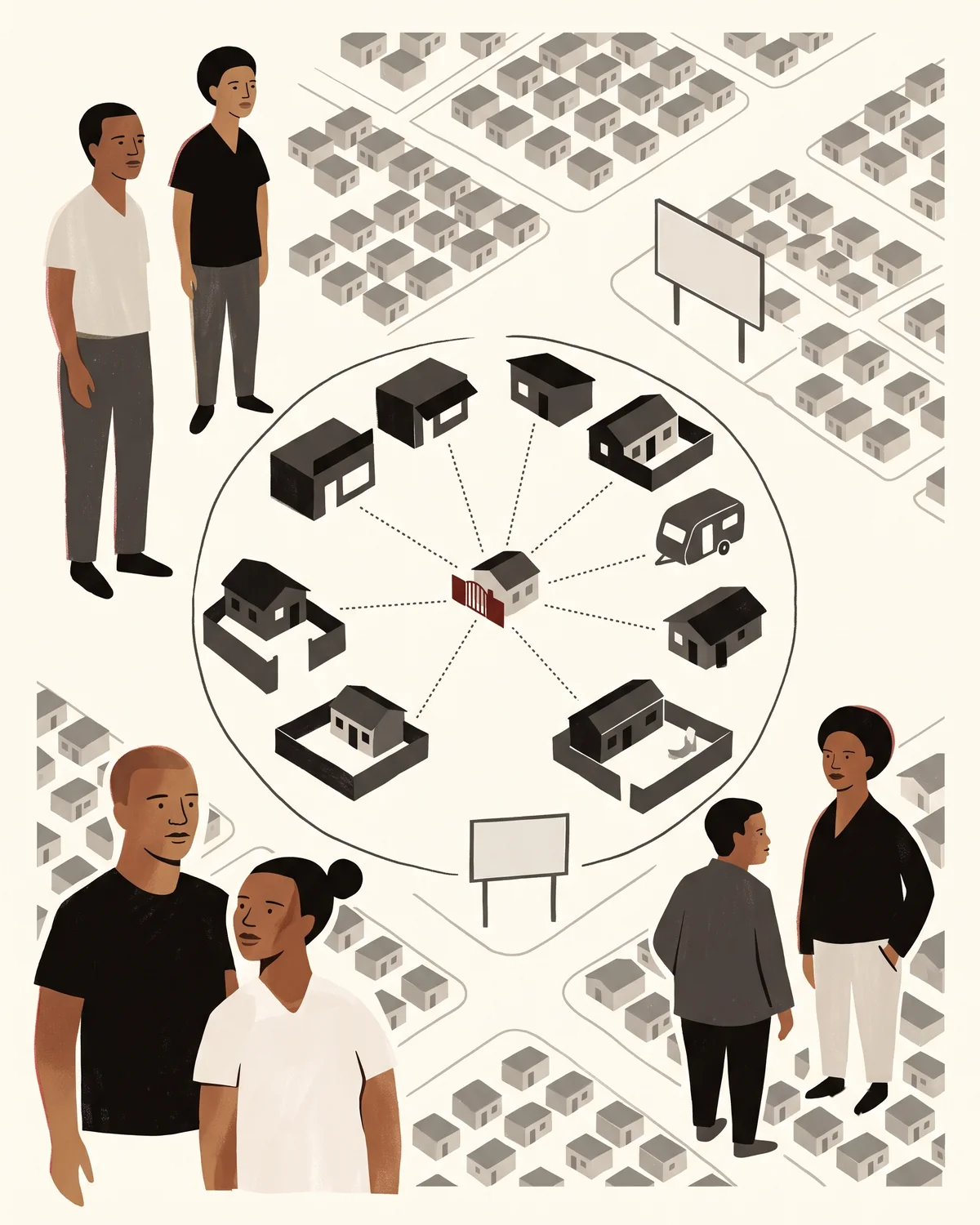
He counts them one Saturday, not because he is worried but because a friend bets him there are more than ten. Within fifteen minutes’ walk of his aunt’s gate: two bottle stores with licences, a Chinese shop that sells beer from a fridge behind the counter, and six houses with a lounge and a fridge and a hatch cut into the burglar bars.
Nine. He loses the bet by one.
The shebeen he settles on is run by a woman called Auntie Bettie who lets him drink on the book until Friday. It has no lights in the yard. The toilet door does not lock. Three men are stabbed there in the years he drinks there, one of them fatally, and Auntie Bettie stays open the following night because closing costs money and the police have no interest.
On the wall behind her, a branded fridge magnet from a distributor. On the corner outside, a billboard: a young man on a beach, laughing, mid-air, holding a bottle. Live it.
The Western Cape has been estimated to hold around 42,000 alcohol outlets, of which between 73% and 83% are unlicensed.[13] Nationally, unlicensed retailers number more than 200,000. Fieldwork in Alexandra found 57 licensed outlets against 244 unlicensed; in Tembisa, 81 against 353.[14]
The unlicensed outlets are also, predictably, the ones without exterior lighting and without locks on the toilet doors, which is its own quiet finding about who is assaulted, and where.[14]
The relationship between outlet density and assault rates is among the more replicated findings in public health, holding across countries and across three decades of study.[15] The standard policy response remains public education, because reducing outlet density removes revenue and public education removes nothing.
Then the advertising. Anderson and colleagues systematically reviewed thirteen longitudinal studies covering more than 38,000 young people. Twelve of the thirteen found that exposure to alcohol marketing predicted both initiation among non-drinkers and increased consumption among those already drinking, with a dose-response relationship in every study that analysed for one.[16] Jernigan’s team repeated the exercise on everything published since and arrived at the same conclusion.[17]
The industry’s reply is that these findings are observational, that correlation is not causation, and that its target market is responsible adults of legal age. Each of those statements is defensible in isolation. None of them constitutes a defence, because the mechanism does not require intent. It requires placement. You buy the audience you want, accept the audience that arrives with it, and publish a code of conduct about the overlap.
Note what the environment has now supplied to a nineteen-year-old carrying a childhood exposure, a genetic loading, and an adolescent initiation. Nine points of purchase within a fifteen-minute walk. Credit until Friday. And a billboard on the corner instructing him to live it.
Nobody in a low-density suburb walks past nine outlets to reach anything. Density tracks poverty with very little error, and we built the exposure by postcode before diagnosing the character of the people standing in it.
IV. The Gap Opens
2007. He is twenty-seven.
He is, by every visible measure, fine.
Site foreman now. A bakkie on finance. A girlfriend, Charmaine, who works at the Shoprite in Bellville and who has told him twice that he drinks too much, in the tone of someone raising a preference rather than a concern.
What he cannot explain, and does not try to, is that he no longer particularly enjoys it.
He notices this on a Thursday. He is four beers in at the shebeen and he is not happy, not loosened, not funny. He is simply somewhere he was always going to end up, doing something he was always going to do, and the wanting that got him there was enormous and specific and had almost nothing to do with pleasure.
He thinks: I don’t even like this.
He orders another one.
In 1993, Robinson and Berridge published the incentive-sensitization theory of addiction. It has since been cited more than nine thousand times and is among the small number of frameworks in this field with a legitimate claim on the word settled.[18]
The claim is narrow, and it is strange. Mesolimbic dopamine systems mediate wanting, the motivational pull toward a reward, rather than liking, its hedonic impact. In vulnerable individuals, repeated drug exposure sensitises those wanting systems, producing an effect that is long-lasting and persists well after use stops. What sensitises is the wanting. Liking does not rise with it.
The precision matters, because the popular version gets it wrong. Robinson and Berridge have spent years correcting the misreading that their theory requires enjoyment to collapse; in their thirty-years-on review they accept some responsibility for the confusion, tracing it to a figure in the original paper.[19] The theory does not require liking to decline. It requires only that wanting grows while liking stays where it was. The gap opens from one side.
Two consequences follow, and both are clinical rather than rhetorical.
First, craving is not a memory of pleasure. It is a sensitised motivational system responding to a cue, and it can fire at full strength in a person who has not enjoyed a drink in years.
Second, this persists. Sensitization outlasts withdrawal by a very long time, which is why relapse remains possible in someone who has been physically well for a decade. Susceptibility varies by genes, sex, hormonal state, prior stress and trauma, and the context and intermittency of use.[19]
Danie’s Thursday is the theory in one sentence. I don’t even like this. He is correct. He orders another one, and that is also correct, because the system doing the ordering was never consulting the one doing the liking.
Incentive sensitization has serious competitors, among them opponent-process accounts and habit-based models. Anyone offering a single mechanism for addiction is selling something. But no version of the moral frame survives any of them. A man cannot exercise judgment over a motivational system that has been structurally rebuilt without his consent, and then be invoiced for the failure.
V. The Floor Moves
2014. He is thirty-four.
Charmaine left in 2011. The bakkie went in 2012. He is on a site in Brackenfell now, taking home less than he did at twenty-seven, and he drinks in the mornings before he goes.
Not for pleasure. Not even for the wanting, particularly. He drinks at six-fifteen in the morning because at six he woke with his hands unsteady and his chest tight and a formless dread sitting on him like weather, and two swallows from the bottle under the bed makes all of it stop.
He is not chasing anything. He is restoring himself to zero, which is where other people apparently begin their days for free.
In September he stops. Twenty-three days. He does it alone, in his room, with paracetamol and sugar water and a bucket, and it is worse than anything he has known.
Day nineteen is the one he will remember, and the shaking had nothing to do with it. On day nineteen nothing was wrong and nothing was good either. He sat on the edge of the bed at four in the afternoon in a room with light coming through the curtain and felt precisely nothing about any of it, and understood, with total clarity, that this was now the ceiling.
He drank on day twenty-four. Not because he wanted to feel good. Because he could not tolerate the absence of feeling anything at all.
Koob and Le Moal described this as allostasis: a hedonic set point that migrates.[20]
He is restoring himself to zero, which is where other people apparently begin their days for free.
The account runs as follows. Repeated heavy use produces two changes in parallel. The reward system becomes less responsive, so the same input yields less output. And, separately, a genuine antireward system is recruited within the extended amygdala. Corticotropin-releasing factor rises. Norepinephrine rises. Dynorphin rises. Neuropeptide Y, which opposes them, falls.[20]
The consequence is that the baseline drops. The person is no longer drinking to elevate mood above normal; he is drinking to return to normal, and normal keeps receding. What began as positive reinforcement becomes negative reinforcement: the removal of an aversive state the drinking itself created.
Koob’s more recent work formalises the resulting state as hyperkatifeia, from the Greek katifeia, dejection: a greater intensity of negative emotional and motivational signs and symptoms during the withdrawal and negative-affect stage of the addiction cycle.[21] Day nineteen has a name. It is a documented feature of the disorder, not a failure of resolve, and it is one of the principal drivers of return to use.
This is where the folk theory collapses entirely. Asked why a man drinks when he clearly no longer enjoys it, the folk theory reaches for weakness. The mechanism says something colder: the machinery that produces relief has been reorganised such that its absence generates suffering. He is not pursuing a high. He is paying rent on a floor that keeps sinking, and the landlord is his own stress system.

VI. The Ban
2020. He is forty.
On the twenty-seventh of March the country closes and the sale of alcohol stops completely.
The first four days are the worst days of his life. On the fifth day he finds he is sleeping. By week three he is eating properly for the first time since Charmaine, and he has weight on him, and his hands are steady enough to hold a cup without using two.
He is not in recovery. There is simply nothing to buy, and the illegal stuff costs six times what he has.
Nine weeks in, he thinks about the farm for the first time in years. About his father at forty-one looking sixty. He is forty.
Sales reopen on the first of June. He does not go that day, or the next.
On the eleventh of June the site closes and he is told there is no work until further notice, and the letter he is handed uses the word regrettably.
He walks to the bottle store the same afternoon. He is not thinking about wanting a drink. He is thinking that something has to absorb this, and everything else that used to absorb things has been sold, left, or shut.
South Africa in 2020 ran an experiment no ethics committee would have approved, then published the results.
Between March and December, the country banned alcohol sales completely, lifted the ban, restricted sales, banned them again, and released them again. Hospitals counted throughout.
Navsaria and colleagues at Groote Schuur in Cape Town documented a 53% fall in trauma patients during the hard lockdown of April and May 2020 compared with the two months before, led by a 74% drop in road traffic injuries; gunshot injuries fell only 15% and rebounded by 80% once restrictions lifted.[22] Worcester Regional Hospital, the district hospital for the farming valley Danie grew up in, ran the full year, reporting trauma admissions per 100 days across five consecutive policy periods: 95 before any ban, 39 under the first complete ban, 74 when sales partially returned, 40 under the second complete ban, and 105 when they were released again.[23]
The line moves with the policy every time, in both directions, at population scale, within weeks.
Then the finding that should have ended a long argument. Mitchells Plain Hospital, serving the Cape Flats where Danie now lives, compared ban periods against restriction periods. Complete bans produced an average of 4.8 fewer trauma patients per day against 2019 equivalents (p<0.001). Partial restrictions produced no significant difference at all (mean −0.4, p=0.19).[24] The national analysis of unnatural deaths across 68 weeks found the same asymmetry: complete restriction produced significant reductions regardless of curfew length, while partial or no restriction showed no significant effect.[25]
The compromise policy, reduced hours and tighter rules, the sensible middle ground that offends nobody, did approximately nothing.
These are ecological studies, and their authors say so. Population-level inference holds; individual-level inference does not.
But the second half of Danie’s year has its own literature, and it is more precise.
Sinha and colleagues examined treatment-engaged alcohol-dependent patients at twenty-eight days abstinent against matched social drinkers. The patients showed elevated basal heart rate and salivary cortisol, and a blunted cortisol response to stress. Stress and alcohol cue each produced an enhanced and persistent craving state marked by increased anxiety and negative emotion.[26] The stress-response system had been rebuilt to under-respond.
A later study followed four-week abstinent patients after discharge. Those showing high provoked craving together with high cortisol and greater cortisol-to-ACTH ratios, a measure of adrenal sensitivity, relapsed more quickly.[27] A 2023 systematic review across 46 studies confirmed the underlying pattern: in early abstinence, stress responses run significantly below those of healthy controls for both ACTH and cortisol.[28]
What this means, in the specific case of a man nine weeks dry when his income is removed, is that the system evolution built to absorb a shock like that had been dismantled years earlier, by the substance he then used to absorb it.
He did not fall off anything. Something pushed, and the thing that was meant to hold gave way, because it had been load-bearing and hollow for a decade.
VII. What He Has
2026. He is forty-six.
Four months, this time. His longest since the ban.
It is a Tuesday in August and the specific facts are these. He has a room. He has piece work, three or four days most weeks, cash. He has a sister in Worcester who phones on Sundays and who cannot read the messages he sends her. He has no medical aid, no counsellor, no group, no doctor who knows his name, and no appointment with anybody at any point in the foreseeable future.
Nine outlets remain within fifteen minutes of where he sleeps. Auntie Bettie died in 2018 but her daughter runs the house.
The man who used to work beside him in Brackenfell stopped drinking in 2019 and has stayed stopped, and Danie has thought about this more than he has told anyone. That man has a wife who did not leave, a brother with a van, a church that fetches him on Sundays, and a permanent contract with UIF and a payslip.
Danie is not in a study. Nobody has counted him. If he drinks on Thursday, no dataset will register it; if he does not drink for another year, no dataset will register that either.
He is standing at the gate on a Tuesday afternoon in the sun, and the question of what happens next is genuinely open, and it does not resolve.
Here is the finding that reorganises everything above it.
In 1996, Granfield and Cloud published a paper titled The elephant that no one sees: Natural recovery among middle-class addicts.[29] Substantial numbers of people resolve severe substance problems without any formal treatment. National survey data later put recovery without treatment among dependent drinkers at around a quarter, though the range moves considerably depending on how recovery is defined and who is counted.[30]
The interesting question was never whether they recovered. It was what they had.
Granfield and Cloud’s answer was recovery capital: the breadth and depth of internal and external resources a person can bring to bear.[31] Personal capital: health, skills, education, self-efficacy. Social capital: relationships, and the people who show up. Physical capital: money, housing, a way to get to work. Cultural capital: belonging, identity, a credible sense that the future contains you. They later added the negative side: stigma, poverty, a criminal record, an address.
Three decades of subsequent evidence have moved in one direction. The volume of a person’s recovery capital appears to matter at least as much to long-term outcome as the severity of their disorder does.
It dismantles the moral frame from underneath. Two men, same diagnosis, same severity, same year of onset. One has a job that will still exist in March, a partner who stayed, a brother with a van, a church that fetches him. The other has a room and a phone call on Sundays. Their outcomes will diverge, and the divergence will not be character.
The field has known this since the nineties and still measures abstinence at thirty days post-discharge, because capital accrues over years and no funding cycle runs that long.
There is a further problem, and it is uncomfortable for everyone. Roughly a quarter of people who meet criteria for alcohol dependence ever receive any treatment at all.[30] The entire outcome literature describes a minority who found a door, and we generalised it to everyone who never did.
And where effective methods exist, we do not use them.
In 1973, Hunt and Azrin published a study that should have settled an argument. Their logic was almost rude in its simplicity: drinking is reinforcing, so to compete with it you need something else that is reliably and repeatedly reinforcing, built into the person’s actual life. They rearranged their participants’ community reinforcers of job, family and social relations, and arranged matters so that drinking produced a time-out from all of it. The men who received this drank less, worked more, spent more time with their families, and spent less time in institutions than matched controls.[32] A subsequent trial found the approach outperformed the hospital’s own Alcoholics Anonymous programme, with better employment and family outcomes alongside.[33]
That was fifty-three years ago. What the field built instead was largely the opposite: confrontation, consequence, the staged intervention, the ultimatum delivered by assembled relatives. Skinner had already observed by 1974 that punishment is a poor instrument for changing human behaviour.[33] A treatment industry was constructed on it anyway, and the failures were filed under non-compliance.
Contingency management tells the same story from a different angle. A meta-analysis across 47 comparisons found an overall effect size of d = 0.42, comfortably in the medium range.[34] A 2025 systematic review of 29 studies (n = 2,615) confirmed significant increases in alcohol-negative samples and alcohol-free days.[35] Fewer than one in ten American opioid treatment programmes uses it.
And the honest limitation, which the enthusiasts skip: prize-based contingency management shows d = 0.46 at end of treatment, 0.33 at three months, and no detectable effect at six.[36] The behaviour held while the reinforcement was running and drifted when it stopped.
That is not the method failing. That is the method telling you exactly what it is. We keep building scaffolds, removing them on schedule, and expressing surprise at the state of the wall.
Coda
Trace the line back from the man at the gate.
A wage paid in wine, to a population that could not leave, beginning in a slave society three and a half centuries ago. A sister in Grade 1 at nine. A finger of wine in a tin, handed over without ceremony. An adolescent nervous system that could not feel the brake. A fifteen-minute walk containing nine points of purchase and a billboard instructing him to live it. A wanting system rebuilt without consent. A floor that moved. A stress axis hollowed out by the thing he used to manage stress. And a labour market that removed his income nine weeks into the longest sober stretch of his adult life.
At no point in that sequence does a moral failure appear, and at almost no point does a choice appear that a reasonable person, holding what he held, would have made differently.
What appears instead is policy. The wage. The licence. The billboard. The zoning. The absence of a counsellor within reach. The thirty-day outcome measure. The funding cycle that ends before capital can accrue.
Willpower is what we call recovery capital in people who already had it.
Danie Fortuin is standing at a gate in the Cape Flats on a Tuesday afternoon in August, four months dry, with a room and a phone call on Sundays and nine outlets within a walk. Whether he drinks this week depends on almost nothing he controls.
The evidence for what would change the odds has been sitting in the journals since 1973.
References
- Williams, G. (2016). Slaves, workers, and wine: The ‘dop system’ in the history of the Cape wine industry, 1658-1894. Journal of Southern African Studies, 42(5), 893-909.
- Gossage, J.P., Snell, C.L., Parry, C.D.H., et al. (2014). Alcohol use, working conditions, job benefits, and the legacy of the “dop” system among farm workers in the Western Cape Province, South Africa. International Journal of Environmental Research and Public Health, 11(7), 7406-7424.
- Western Cape Liquor Act; reported in South African Government News Agency, “Farmers using ‘dop system’ face up to R1mil fine.”
- May, P.A., et al. (2017). Replication of high fetal alcohol spectrum disorders prevalence rates, child characteristics, and maternal risk factors in a second sample of rural communities in South Africa. International Journal of Environmental Research and Public Health, 14(5), 522.
- May, P.A., de Vries, M.M., Marais, A.S., et al. (2022). The prevalence of fetal alcohol spectrum disorders in rural communities in South Africa: a third regional sample of child characteristics and maternal risk factors. Alcoholism: Clinical and Experimental Research, 46(10), 1819-1836. PMID 35971629.
- Lange, S., et al. (2017). Global prevalence of fetal alcohol spectrum disorder among children and youth. JAMA Pediatrics, 171(10), 948-956.
- Popova, S., Lange, S., Probst, C., Gmel, G., & Rehm, J. (2017). Estimation of national, regional, and global prevalence of alcohol use during pregnancy and fetal alcohol syndrome. Lancet Global Health, 5(3), e290-e299.
- Verhulst, B., Neale, M.C., & Kendler, K.S. (2015). The heritability of alcohol use disorders: a meta-analysis of twin and adoption studies. Psychological Medicine, 45(5), 1061-1072.
- Felitti, V.J., Anda, R.F., et al. (1998). Relationship of childhood abuse and household dysfunction to many of the leading causes of death in adults. American Journal of Preventive Medicine, 14(4), 245-258.
- Spear, L.P. (2000, and subsequent). The adolescent brain and age-related behavioral manifestations. Neuroscience & Biobehavioral Reviews, 24(4), 417-463. Note: mechanistic findings substantially derived from rodent models with growing human corroboration.
- Grant, B.F., & Dawson, D.A. (1997). Age at onset of alcohol use and its association with DSM-IV alcohol abuse and dependence. Journal of Substance Abuse, 9, 103-110.
- Maimaris, W., & McCambridge, J. (2013). Age of first drinking and adult alcohol problems: systematic review of prospective cohort studies. Journal of Epidemiology and Community Health, 68(3), 268-274.
- Smit, W. (2014). Discourses of alcohol: reflections on key issues influencing the regulation of shebeens in Cape Town. South African Geographical Journal, 96(1), 60-80.
- 2019 outlet research in Alexandra and Tembisa, reported in Peacock, D., Wasserman, Z., Rebombo, D., & Sehoanea, S. (2022). If they are to effectively address alcohol harm, provincial liquor boards need to be strengthened. Daily Maverick, 14 August.
- Scribner, R.A., et al. (1995); Gruenewald, P.J., et al.; Chikritzhs, T., et al.; summarised in NSW Bureau of Crime Statistics and Research bulletins.
- Anderson, P., de Bruijn, A., Angus, K., Gordon, R., & Hastings, G. (2009). Impact of alcohol advertising and media exposure on adolescent alcohol use. Alcohol and Alcoholism, 44(3), 229-243.
- Jernigan, D., Noel, J., Landon, J., Thornton, N., & Lobstein, T. (2017). Alcohol marketing and youth alcohol consumption: a systematic review of longitudinal studies published since 2008. Addiction, 112(S1), 7-20.
- Robinson, T.E., & Berridge, K.C. (1993). The neural basis of drug craving: an incentive-sensitization theory of addiction. Brain Research Reviews, 18(3), 247-291.
- Robinson, T.E., & Berridge, K.C. (2025). The incentive-sensitization theory of addiction 30 years on. Annual Review of Psychology, 76, 29-58.
- Koob, G.F., & Le Moal, M. (2008). Addiction and the brain antireward system. Annual Review of Psychology, 59, 29-53. See also Koob, G.F., & Le Moal, M. (1997). Drug abuse: hedonic homeostatic dysregulation. Science, 278(5335), 52-58; and Koob, G.F., & Le Moal, M. (2001). Drug addiction, dysregulation of reward, and allostasis. Neuropsychopharmacology, 24(2), 97-129.
- Koob, G.F. (2021). Drug addiction: hyperkatifeia/negative reinforcement as a framework for medications development. Pharmacological Reviews, 73(1), 163-201. PMID 33318153. See also Koob, G.F. (2020). Biological Psychiatry, 87(1), 44-53. Term coined by Shurman, Koob & Gutstein (2010).
- Navsaria, P.H., Nicol, A.J., Parry, C.D.H., Matzopoulos, R., Maqungo, S., & Gaudin, R. (2020). The effect of lockdown on intentional and nonintentional injury during the COVID-19 pandemic in Cape Town, South Africa: A preliminary report. South African Medical Journal, 111(2), 110-113. DOI 10.7196/SAMJ.2021.v111i2.15318. PMID 33944719. Note: a widely circulated 66% figure was relayed in Reuter, H., Jenkins, L.S., De Jong, M., Reid, S., & Vonk, M. (2020), African Journal of Primary Health Care & Family Medicine, 12(1), a short report that repeated a Groote Schuur Hospital statement from the media without analysing it. The 53% figure above is the peer-reviewed estimate and should be preferred.
- Chu, K.M., et al. (2022). Trauma trends during COVID-19 alcohol prohibition at a South African regional hospital. Drug and Alcohol Review, 41(1), 13-19. DOI 10.1111/dar.13310. PMID 33998731. Retrospective analysis, 1 January to 28 December 2020, Poisson regression across five policy periods. Stellenbosch University, Worcester Regional Hospital and the South African Medical Research Council.
- Van Hoving, D.J., et al. (2021). Temporal changes in trauma according to alcohol sale restrictions during the South African national COVID-19 lockdown. African Journal of Emergency Medicine, 11(4), 477-482.
- Moultrie, T.A., et al. (2021). Unnatural deaths, alcohol bans and curfews: evidence from a quasi-natural experiment during COVID-19. 68 weeks, January 2020 to April 2021. South African Medical Journal. Ecological design; individual-level inference not supported.
- Sinha, R., Fox, H.C., Hong, K.A., Bergquist, K., Bhagwagar, Z., & Siedlarz, K.M. (2009). Enhanced negative emotion and alcohol craving, and altered physiological responses following stress and cue exposure in alcohol dependent individuals. Neuropsychopharmacology, 34(5), 1198-1208. DOI 10.1038/npp.2008.78. PMID 18563062.
- Sinha, R., Fox, H.C., Hong, K.I., Hansen, J., Tuit, K., & Kreek, M.J. (2011). Effects of adrenal sensitivity, stress- and cue-induced craving, and anxiety on subsequent alcohol relapse and treatment outcomes. Archives of General Psychiatry, 68(9), 942-952.
- HPA axis function in alcohol use disorder: a systematic review and meta-analysis (2023). 46 studies. Early abstinence stress response vs healthy controls: ACTH SMD = −1.47, cortisol SMD = −1.32, both p < .001.
- Granfield, R., & Cloud, W. (1996). The elephant that no one sees: Natural recovery among middle-class addicts. Journal of Drug Issues, 26(1), 45-61.
- Dawson, D.A., et al. (2005). Recovery from DSM-IV alcohol dependence: United States, 2001-2002. NESARC. Treatment utilisation 25.5%; natural recovery 24.4%. Range across surveys is wide (NLAES >70%; German samples ~40%) and definition-dependent.
- Granfield, R., & Cloud, W. (1999). Coming Clean: Overcoming Addiction Without Treatment. New York University Press, p. 179. See also White, W., & Cloud, W. (2008). Recovery capital: A primer for addictions professionals.
- Hunt, G.M., & Azrin, N.H. (1973). A community-reinforcement approach to alcoholism. Behaviour Research and Therapy, 11(1), 91-104. PMID 4781962.
- Azrin, N.H. (1976); Skinner, B.F. (1974), About Behaviorism; both discussed in Meyers, R.J., Roozen, H.G., & Smith, J.E. (2011), NIAAA Alcohol Research & Health, 33(4), 380-388.
- Prendergast, M., et al. (2006). Contingency management for treatment of substance use disorders: a meta-analysis. Addiction, 101(11), 1546-1560. d = 0.42 across 47 comparisons.
- Alessi, M.R., et al. (2025). Contingency management for unhealthy alcohol use: a systematic review and meta-analysis. Alcohol, Clinical and Experimental Research. 29 studies, n = 2,615.
- Benishek, L.A., et al. (2014). Prize-based contingency management for the treatment of substance abusers: a meta-analysis. Addiction. d = 0.46 end-of-treatment; 0.33 at ≤3 months; −0.09 at 6 months. On uptake among opioid treatment programmes, see Becker, S.J., et al. (2023), Implementation Science, 18, 41.
The letter
One letter with each new piece. Nothing else, and your address goes nowhere.
We send one confirmation email. You are not on the list until you click it.



Replies
Nothing here yet.
Replies are for subscribers, signed in.
Sign inNot a subscriber yet?