Estrangement Is Rarely One Fight
Parents remember the argument. Their children remember the twenty years before it.
Relationships · · 9 min readMrs Rao eats lunch at one, at the dining table, with her phone beside the plate. Face up. She turned off the silent mode two years ago and has not turned it back on, including at night, including at the temple, where it once went off during the aarti and she did not apologise. Her daughter Shruti lives in Toronto. The last call was two years and three months ago. Mrs Rao can give you the date.
She can also give you the cause, and does, to her sister, to the neighbour, to the woman who comes to cook. There was a quarrel about the guest list for Shruti’s wedding reception. Things were said on both sides. Shruti has always been sensitive, and these days, abroad, they are all reading things on the internet about their parents. It was one fight. People do not throw away a mother over one fight.
In Toronto there is a document. Shruti began it on her laptop some years ago, on the advice of nobody, because she had started to doubt her own memory. It runs to eleven pages. The wedding is on page nine.
Composite. Mrs Rao and Shruti are composites, with details altered. Neither account is offered as the correct one.
Two honest accounts
The most useful thing researchers have learned about family estrangement is how differently the two sides describe the same break.
Ask estranged parents, and they tend to name an event and an outside influence: the argument, the divorce, the son-in-law, the therapist, the move abroad. Many say they were never given a reason. Ask estranged adult children, and they almost never name an event. They describe a climate. Years of criticism, or of being compared, or of a parent’s moods running the house. Feelings that were mocked or treated as disloyalty. A sense, finally put into words somewhere around thirty, of not having been seen. The quarrel the parent remembers was, for them, only the day they stopped trying.
The quarrel the parent remembers was, for the child, only the day she stopped trying.
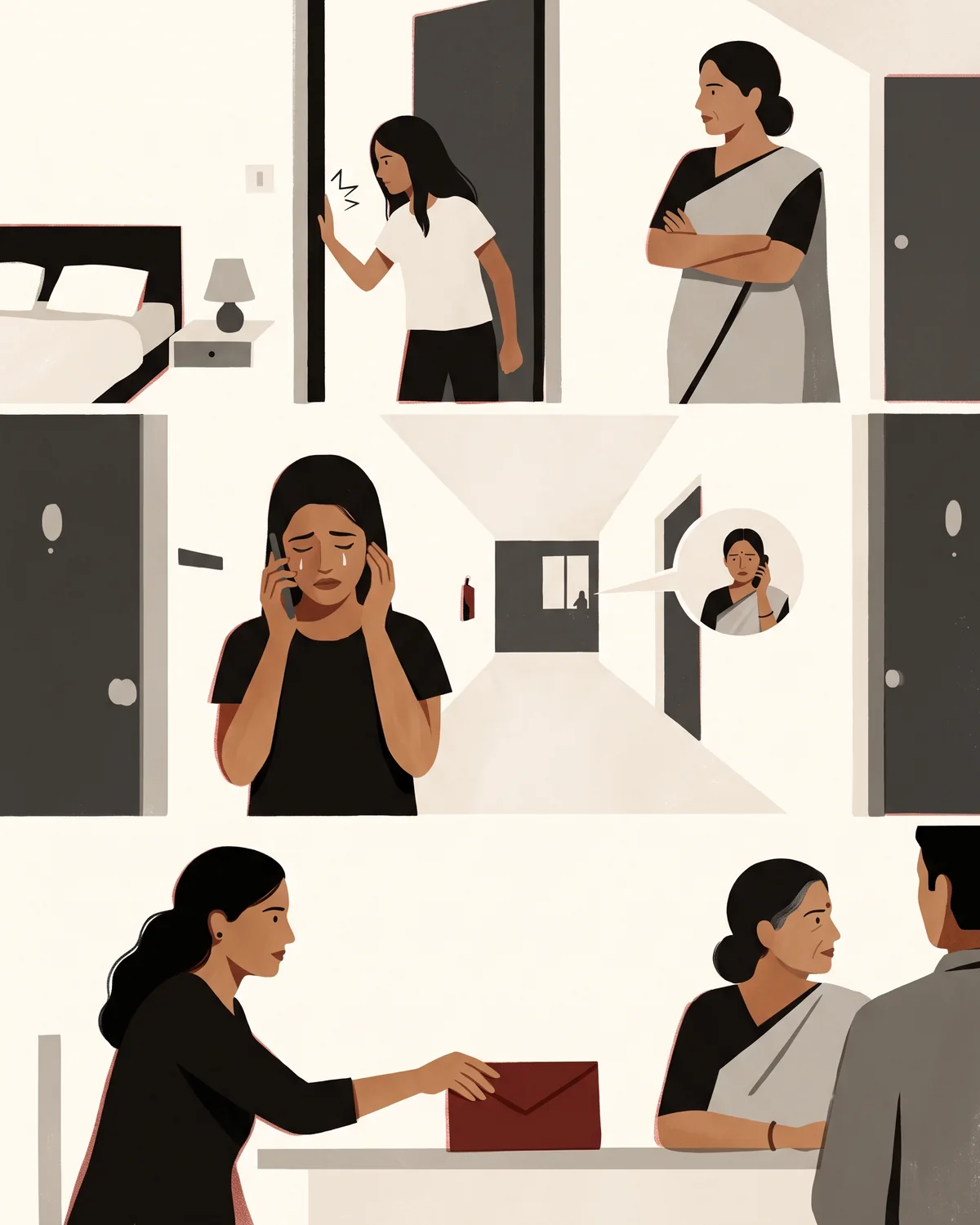
It is tempting to decide that one of them is lying. Usually neither is. Mrs Rao does not know why, and is not pretending. But it is also true that Shruti told her, many times, across fifteen years. She told her at fourteen by slamming a door, which was read as adolescence. She told her at twenty-two in a long, tearful phone call from the hostel, which was read as exam stress. She told her at twenty-nine in a four-page letter, which was read as an attack, shown to two aunts, and answered with a list of sacrifices. Each telling arrived in a form that could be filed under something else. The message was sent. It was never received.
People who study estrangement describe it as a wearing away and rarely as a rupture. The final silence is only the visible part. Shruti did not leave in one fight. She left over about two hundred Sunday calls, each a little shorter than the last.
The wrong syllabus
Something should be said for Mrs Rao, because she will not say it well herself.
Her own mother hit her with a steel ladle, regularly, and nobody in the house or the street thought it worth a remark. She was married at twenty to a man she had met twice. By the standards she was handed, she has been an exceptionally gentle and devoted parent. She never raised a hand. She sat up through every board exam with a flask of coffee. When the Toronto fees came due she sold the bangles from her wedding and told no one. She compared Shruti to her cousins because that was how one encouraged a child, and she commented on her weight because nobody else would be honest with the girl, and she read the diary because a mother is supposed to know.
She is now being assessed on attunement, privacy and emotional validation, none of which existed as ideas when she was doing the work. It is as if she sat an examination, passed it with distinction, and was informed thirty years later that it had been the wrong syllabus. Her bewilderment is not an act. It also changes nothing about what it was like to be her daughter.
The respectable version
All this can sound like a Western ailment, a thing that happens to people who put their parents in homes. One large American survey found that more than a quarter of adults were estranged from a close relative. No comparable number exists for India, and if it did, it would be low and would mean very little.
Because here estrangement seldom announces itself. A child who stops speaking to her mother becomes a scandal, so very few do. What happens instead is quieter and extremely common. The call comes once a fortnight, lasts four minutes, and consists entirely of logistics: did the money reach, has the plumber come, take your tablets. Visits are annual, brief, and spent largely at the in-laws’. Nothing personal has been said by either party since about 2016. Everyone agrees that the children are very busy.
And then there is the visa. For two generations, going abroad has been the most admired thing an Indian child could do, and nobody looks closely at what else it accomplishes. Twelve thousand kilometres and a ten-hour time difference will enforce a boundary that no daughter could have asked for out loud. The parents tell the neighbours, with pride, that she is in Canada. Some of those children chose the country and the distance came with it. For others it was the other way round, and the family has made sure never to find out which.
Low contact
Staying in touch with a parent just enough to avoid a break: the dutiful call, the festival visit, nothing real exchanged. In India it is rarely named, because it is indistinguishable from being busy, and that is the point of it.
What the internet added
It is true, as Mrs Rao suspects, that they are all reading things.
There are now very large online communities built around the idea of going “no contact” with harmful parents. For a person who grew up with real cruelty, and there are many, finding such a place is like discovering that the odd, unnameable weather of their childhood has a forecast and other survivors. The permission it gives can save a life. It is not an exaggeration to say so.
The same rooms hold another kind of reader, and the vocabulary does not distinguish between them. Words that were built for serious harm, toxic, narcissist, abuse, get applied to a mother who is anxious, intrusive, tactless about weight and hopeless at apologising: a description that fits perhaps half the mothers in the country. A forum will rarely say, that sounds painful, and also ordinary, and it might be survivable with some distance and a few firm rules. A forum says: you owe them nothing. Sometimes that is correct. It is always the more satisfying thing to be told.
So there are two errors available, and each generation is sure that only the other one is being made. Some parents did lasting damage and have rewritten it as strictness. Some children have taken the normal failures of a limited, loving person and promoted them to a diagnosis. From outside, and often from inside, the two cases look identical. Both feature a hurt parent who says she did her best, and an adult child who says that her best is the problem.
The phone call that does not happen
Can it be repaired?
Sometimes. Where it happens, the accounts are fairly consistent about how. The parent who gets a child back is nearly always one who stopped arguing the case. She did not explain her intentions, produce the list of sacrifices, or correct the child’s memory of 1998. She said some version of: tell me, and I will not defend myself. And then managed not to, which is a great deal harder than it sounds, for about a year. Nothing else has much of a record. Guilt does not work. Relatives sent as ambassadors do not work. Turning up unannounced works least of all.
This is a bitter prescription for a woman of sixty-eight who gave up a job for her children and whose own mother never apologised to anyone. It asks her to accept a version of herself that she does not recognise, from the person whose opinion of her matters most. Many parents cannot do it. They would sooner have the grief, which at least leaves them in the right.
The child’s side is no easier, only less discussed. Estrangement is not the clean relief the forums advertise. People who have cut off a parent describe a grief that has no funeral and no end date, because its object is alive and ageing in a flat in Mysuru. They dread one particular phone call, from a cousin, at a strange hour. They wonder what they will feel. Some of them worked out long ago that they do not want a better apology. They want a different childhood, and they have understood that no phone call contains one.
Nor is it ever only two people. Shruti has a brother, Arjun, in Bengaluru, who has been appointed to a post he did not seek. He is told things by his mother with the instruction not to pass them on, and by his sister with the same instruction, and both are hurt when he obeys. He hosts Deepavali each year with a gap at the table that the whole family eats around. His children have a Toronto aunt whom they know as a voice on his phone. He has tried, twice, to mediate, and learned that each woman took his effort as evidence that he was on the other’s side. An estrangement redraws the whole family, and the people in the middle pay a share of it without having been party to any of the original offences.
So both of them wait. Each believes the next move belongs to the other. Each has composed the opening sentence of that conversation many times, and each version begins with the other person admitting something.
At ten past one, halfway through the rice, the phone on Mrs Rao’s table lights up and shudders against the wood. Her hand is on it before the second buzz.
It is the gas agency, confirming that her cylinder has been booked and will be delivered within two working days.
She reads the message to the end, as she reads everything. Then she puts the phone back beside her plate, face up, and squares it with the edge of the mat.
Sources
- Pillemer, K., Fault Lines: Fractured Families and How to Mend Them (Avery, 2020). Includes the national US survey in which 27 per cent of adults reported a current estrangement from a relative.
- Carr, K., Holman, A., Abetz, J., Koenig Kellas, J. and Vagnoni, E. (2015). “Giving voice to the silence of family estrangement: comparing reasons of estranged parents and adult children in a nonmatched sample.” Journal of Family Communication, 15(2), 130 to 140.
- Scharp, K. M. and Dorrance Hall, E. (2017). “Family marginalization, alienation, and estrangement: questioning the nonvoluntary status of family relationships.” Annals of the International Communication Association, 41(1), 28 to 45. Estrangement as a gradual process.
- Coleman, J., Rules of Estrangement (Harmony, 2021). A clinician’s account of what does and does not bring adult children back.
The letter
One letter with each new piece. Nothing else, and your address goes nowhere.
We send one confirmation email. You are not on the list until you click it.

Replies
Nothing here yet.
Replies are for subscribers, signed in.
Sign inNot a subscriber yet?