The Practice
You are reading this for yourself, or you are reading it for somebody who does not know the tab is open. Both of you can carry on. Nothing here is written to be printed out and used as evidence against the other one.
You may be reading it at an hour you would not admit to. Nothing on this page asks for your name.
You are not required to have decided anything before you write in. Not to stop, and not to call it anything in particular. The first conversation can be about whether there is a problem at all.
The hour, and the writing
Sessions run fifty minutes, whatever the work is about. Talk can be steered, and fifty minutes can end somewhere safer than where they began. We know. We have sat in the client’s chair too.
When the work is drinking or using, there is writing as well, in one of the programmes. Writing is slower than speech and less obliging. It also stays put. The chapter you wrote in March is still there in June, and so is the distance you have covered since.
What you write is read. We read it, and the next session of a programme opens only when we release it. There is no timer and no cohort.
The programmes
There are six, and they came out of the work itself. One runs thirty sessions. One runs five. Baseline comes first, and decides which of the others is the right one, or whether none of them is.
Who you would be writing to
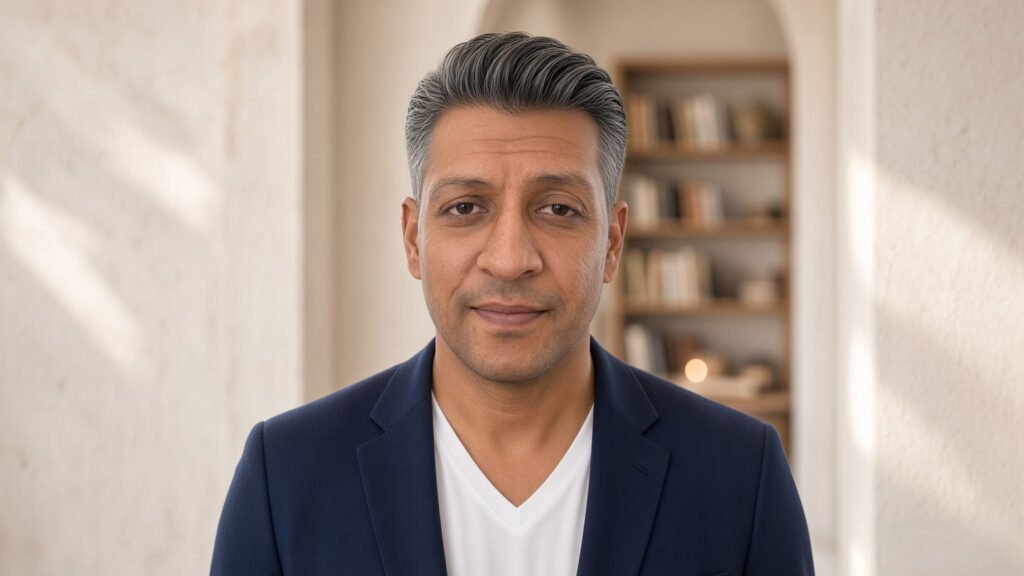
Rohit R. Vangimalla
Founder and clinical lead
Much of the work behind this practice was research. I followed people over long stretches of serious illness and watched what treatment changed and what it did not, in the measures and in their own accounts of themselves. It settled the thing the practice is built on. Recovery is uneven, it is measurable, and the measure and the person routinely disagree.
Since then I have trained in addiction and substance use, and in cognitive behavioural therapy. The work draws on both and is precious about neither.
What I work with. Everything this page has already named, anxiety, low mood, grief, a family that has agreed not to notice. And substance use disorder, and the things that arrive with it, which is usually most of a life: the relapse that keeps happening at the same point, the relationships being managed rather than had, the resentment nobody has said out loud, and the gap between the account a person gives of their week and the account the week gives of them. People who have tried to stop before. People sent by somebody else. People who have not yet told anyone.
How. Online, wherever you are, in India or outside it, and in the room where that can be arranged. The written programmes on this site are mine, built from running this work with people one at a time, then rewritten for somebody alone with a screen rather than sitting in a group in a room.
I do not diagnose for anybody else’s purposes and I do not prescribe. Where what you need is medical, or more than this, I will say so early rather than late.
The clinician you write to is the clinician you sit with. Nothing is handed down to somebody more junior. Beyond that, three people can reach your record, and the Privacy Policy sets each out: the clinician covering for yours, the person who runs the practice, who answers for every client, and the person who keeps the site running, only to maintain or restore it and never as reading matter. Nobody else.
How to start
It starts with the intake form. The form is stored on this site and copied to the clinical lead’s inbox, so that it is not sitting unread behind a login. The clinical lead reads every one. It is never visible to a search engine and it goes to nobody else.
Then a conversation. It comes within the next working day, and on weekends and holidays too, though perhaps later in the day. If the form carries a phone number, expect a call as well. Places are not sold from this page and there is no checkout for them. If the work suits you, we make the account by hand and release the first session.
Either of you can send the form. The conversation settles who is going to do the work, and that is not always the person who sent it.
The fee is agreed before the first session and not after it. We keep a limited number of reduced-fee hours open, and asking about them is not a negotiation you have to win.
If cost is the thing standing in the way, write that into the form. It is an ordinary thing to write and it gets an ordinary answer.
- iam@idinsayit.com
- +91 92700 86548
If you would rather read something first
Two long essays sit closest to what this page is for: Paid in Wine, on how alcohol dependence gets built, and Next of Kin, on the family as addiction’s second patient. Both are made the same way, seven scenes with the evidence laid out beneath them, everything outside the italics sourced. If you are the one who never wanted to be reading any of this, start with Next of Kin.
There is also a poetry collection, The Door Stays Unlocked, and two works of fiction in private circulation, Dreams Never Told and The Quiet Room. None of it is a qualification. It is there so that you can hear how the subject gets handled before you decide to hand yours over.
What this is not
We do not diagnose for anybody else’s purposes and we do not prescribe. Where what you need is medical, or more than this, we will say so early rather than late.
This is not an emergency service. Enquiries are not monitored in real time.
Something sent at three in the morning is not read until the morning. If tonight will not wait that long, do not wait for us. In India: Tele-MANAS on 14416, free and answered around the clock. In the daytime there is also iCall on 9152987821, Monday to Saturday, eight in the morning to nine at night. For immediate danger, an overdose, or a risk to life: 112, or your nearest emergency department. Outside India, your own emergency number. Waking somebody in the house counts too.
Then write to us tomorrow.